15 Best Generative Engine Optimization (GEO) Agencies in 2026
If you’re still measuring digital success purely by Google rankings, you’re already behind. Something fundamental shifted in how people find information, and it happened faster than most marketing teams expected.
Users are no longer just searching. They’re asking. And AI is answering.
When someone asks ChatGPT, “What’s the best accountant for a small business in Melbourne?” or asks Perplexity, “Which marketing agency should I hire for SEO?”, they don’t get ten blue links. They get a direct answer, with specific brand recommendations, backed by citations. If your business isn’t one of those recommendations, you don’t exist in that moment.
That’s the problem Generative Engine Optimization (GEO) solves. GEO is the practice of optimising your content, authority signals, and digital presence so that AI-powered platforms, including ChatGPT, Google AI Overviews, Perplexity, Gemini, and Microsoft Copilot, cite and recommend your brand when answering relevant queries.
The numbers make the urgency clear. According to eMarketer’s 2026 GEO report, fewer than 10% of sources cited in ChatGPT, Gemini, and Copilot rank in the top 10 Google organic search results for the same query. Traditional SEO alone will not get you into AI answers. You need a dedicated GEO strategy.
The challenge? GEO is still a new discipline. Most agencies are still catching up. Only a handful have built genuine, proven frameworks for getting brands cited consistently across AI platforms.
We’ve done the research to find them. Here’s our list of the 15 best GEO agencies in 2026, what each one does best, and how to choose the right fit for your business.
Key Takeaway: GEO and SEO are complementary, not competing. The brands winning in AI search are those that invest in both, not one or the other.
What Is Generative Engine Optimization (GEO)?
Generative Engine Optimization is the practice of structuring your content and digital presence so that AI-powered search platforms can retrieve, understand, and cite your brand when generating answers for users.
Traditional SEO asks: “Are we ranking on page one?” GEO asks: “Are we inside the answer?”
According to Search Engine Land’s 2026 GEO guide, when an AI engine names your brand in its response, it delivers an implicit endorsement that no organic listing ever could. AI platforms typically cite only two to seven domains per response, making the competition more selective than a Google SERP.
How GEO Differs from Traditional SEO
|
Aspect |
Traditional SEO |
Generative Engine Optimization |
|---|---|---|
|
Output format |
List of clickable links |
Synthesised narrative response |
|
User behaviour |
User clicks through to find information |
User gets the answer directly |
|
Query length |
Short keywords (avg. 4 words) |
Conversational questions (avg. 23 words) |
|
Success metrics |
Rankings, CTR, organic traffic |
Citations, brand mentions, share of voice |
|
Optimisation focus |
Keywords and backlinks |
Content structure and authority signals |
|
The key question |
“Are we on page one?” |
“Are we in the answer?” |
What GEO Actually Involves
A proper GEO strategy covers four interconnected areas:
-
Content structure: Publishing information that AI systems can discover, extract, and reassemble into answers. Self-contained paragraphs, clear headings, and direct definitions are essential.
-
Entity authority: Establishing your brand as a recognised, trusted entity across platforms where AI tools pull information, including review sites, industry publications, and social platforms.
-
Technical foundations: Ensuring AI crawlers (GPTBot, ClaudeBot, PerplexityBot) can access and parse your content. Schema markup, clean site architecture, and an
llms.txtfile all play a role. -
Reputation signals: Earning third-party mentions, citations, and reviews that signal credibility to AI systems. Princeton research confirms that AI engines strongly favour earned media over brand-owned content.
GEO isn’t a one-time project. It’s an ongoing discipline that demands the same rigour as traditional SEO.
Quick Comparison: 15 Best GEO Agencies at a Glance
Before diving into the full profiles, here’s a high-level snapshot to help you quickly identify which agency fits your situation.
|
# |
Agency |
Best For |
Location |
|---|---|---|---|
|
1 |
Global Genie Marketing |
Full-service GEO + SEO for Australian businesses |
Australia |
|
2 |
Go Fish Digital |
Semantic GEO audits for eCommerce and B2B |
Washington, DC |
|
3 |
Omniscient Digital |
Topical authority GEO for B2B SaaS |
Austin, TX |
|
4 |
Siege Media |
Content-led GEO for B2C brands |
San Diego, CA |
|
5 |
Intero Digital |
Full-funnel GEO via proprietary GRO framework |
Fort Wayne, IN |
|
6 |
WebFX |
Enterprise GEO via OmniSEO platform |
Harrisburg, PA |
|
7 |
iPullRank |
Technical GEO for large enterprise sites |
New York, NY |
|
8 |
NoGood |
GEO inside growth marketing for VC-backed startups |
New York, NY |
|
9 |
RevenueZen |
Revenue-focused GEO tied to pipeline metrics |
Portland, OR |
|
10 |
Victorious |
GEO governance for enterprise eCommerce |
San Francisco, CA |
|
11 |
Minuttia |
B2B SaaS GEO with entity authority and digital PR |
Remote |
|
12 |
Rock The Rankings |
Specialist GEO for B2B SaaS brands |
Remote |
|
13 |
Brafton |
Scalable content production GEO |
Boston, MA |
|
14 |
Single Grain |
GEO for growth-stage and funded brands |
Los Angeles, CA |
|
15 |
Foundation |
GEO through research-led content and distribution |
Toronto, Canada |
The 15 Best GEO Agencies in 2026
1. Global Genie Marketing
Best for: Australian businesses wanting full-service GEO and AI SEO integrated with a traditional search strategy
Location: Australia |
Services: GEO, AI SEO, Local SEO, Content, PPC, Web Design
Global Genie Marketing is a full-service digital marketing agency built for the Australian market, with a growing focus on Generative Engine Optimization as AI search adoption accelerates. What sets Global Genie apart from most agencies on this list is the combination of deep local market knowledge with a forward-looking AI visibility strategy.
Rather than treating GEO as a standalone add-on, Global Genie integrates AI search optimisation into the broader SEO and content program. That means your brand isn’t just ranking on Google; it’s being cited by ChatGPT, Perplexity, and Google AI Overviews when prospects in your market are asking buying-intent questions.
Key GEO capabilities:
-
AI-ready content structuring and entity optimisation
-
Schema markup implementation for AI crawler accessibility
-
Local authority building through citations, reviews, and third-party mentions
-
Content strategy designed for AI extraction and citation
-
Integrated SEO + GEO measurement and reporting
Industries served: Accountants, healthcare, real estate, e-commerce, and professional services across major Australian cities.
Ideal client: Australian SMEs and growth businesses that want one partner managing both traditional SEO and AI search visibility, without splitting budgets across multiple agencies.
2. Go Fish Digital
Best for: Semantic GEO audits for eCommerce and large B2B sites
Location: Washington, DC |
Clutch rating: 5.0/5 |
Pricing: $6,000 to $20,000+/month
Go Fish Digital approaches GEO through a combination of semantic content audits, passage-level optimisation, and digital PR. Their internal toolkit includes a Semantic Content Audit, an AI Overview Analyser, and a proprietary tool called Barracuda, which evaluates pages against 14 factors tied to Google patent signals.
Their process starts by mapping how AI systems currently interpret your topic coverage, then goes page by page to improve structure and fact density. Notable clients include GEICO, Wayfair, and Jelly Belly.
Key GEO capabilities:
-
Semantic content audits mapped to AI retrieval patterns
-
Passage-level content optimisation
-
Digital PR for citation building
-
AI Overview: performance tracking
3. Omniscient Digital
Best for: B2B SaaS brands with high-intent, long-tail content strategies
Location: Austin, TX |
Pricing: Custom |
Notable clients: SAP, Adobe, Jasper, Loom
Omniscient Digital takes a content-led approach to GEO, building topical authority through entity work, citation engineering, and strategic digital PR. They focus on narrow, high-intent topic areas, which makes them a strong fit for B2B SaaS brands where buyer journeys are long and AI-assisted research is common.
Their approach goes beyond publishing content. They engineer citation opportunities by identifying which AI-cited sources in a given topic cluster are earning citations, then reverse-engineering why.
Key GEO capabilities:
-
Topical authority mapping and content gap analysis
-
Entity optimisation for AI knowledge graphs
-
Citation engineering via digital PR
-
Pipeline-focused GEO measurement
4. Siege Media
Best for: Content-heavy B2C brands investing in long-term AI search visibility
Location: San Diego, CA |
Clutch rating: 4.9/5 |
Notable clients: Adidas, EverlyWell, Zendesk
Siege Media is one of the most consistently cited GEO agencies across multiple 2026 rankings. Their strength is data-driven content production combined with a focus on content freshness, which matters significantly for AI citation patterns. AI engines tend to favour recently updated, factually dense content.
They also run original research programmes, which generate the kind of primary data that AI engines love to cite. If your GEO strategy needs authoritative, citable content at scale, Siege Media is a strong choice.
Key GEO capabilities:
-
Original research and data-driven content production
-
Content freshness and update programmes
-
Digital PR for third-party citation building
-
B2C content strategy aligned to AI retrieval
5. Intero Digital
Best for: Mid-market and enterprise brands wanting full-funnel GEO
Location: Fort Wayne, IN |
Clutch rating: 4.8/5 (143 reviews) |
Experience: 29+ years
Intero Digital packages its GEO service under the proprietary Intero GRO framework, combining traditional SEO, digital PR, entity-based content, and technical optimisation. They also enable and monitor AI-specific crawlers (PerplexityBot, GPTBot) as part of their technical setup, which many agencies overlook.
Their 29+ years of SEO experience mean they understand how to layer AI visibility strategy onto an existing, mature search programme without disrupting it.
Key GEO capabilities:
-
Intero GRO framework for full-funnel AI visibility
-
AI crawler monitoring and technical setup
-
Entity-based content strategy
-
Internal linking and structured sitemaps optimised for AI retrieval
6. WebFX
Best for: Brands that want GEO delivered inside a broader digital marketing programme
Location: Harrisburg, PA |
Clutch rating: 4.9/5 (441 reviews) |
Experience: 30+ years
WebFX delivers GEO through their proprietary OmniSEO platform, which tracks AI visibility across ChatGPT, Perplexity, Google AI Overviews, Copilot, and Meta AI simultaneously. With over 441 Clutch reviews and three decades of digital marketing experience, they’re one of the most credentialed agencies on this list.
Their scale means they can handle GEO for large, complex websites with multiple product lines or geographic markets.
Key GEO capabilities:
-
OmniSEO platform with AI visibility tracking across five major AI engines
-
Technical SEO and schema markup implementation
-
Authority content production at scale
-
Trust signal management for AI citation eligibility
7. iPullRank
Best for: Enterprise organisations with strict brand controls and complex site architectures
Location: New York, NY |
Pricing: $10,000 to $20,000+/month
iPullRank integrates technical SEO with structured data strategies specifically designed for AI-driven discovery. Their team handles complex site architecture, JavaScript rendering, content engineering, log file analysis, and enterprise-level schema validation for FAQ and HowTo formats.
For large organisations where brand accuracy in AI responses is a compliance or legal concern, iPullRank’s governed GEO approach (which includes internal training, prompt testing, and quality assurance) is particularly valuable.
Key GEO capabilities:
-
Enterprise-level technical GEO and schema validation
-
JavaScript rendering optimisation for AI crawlers
-
Governed GEO with brand accuracy QA
-
Log file analysis for AI bot behaviour
8. NoGood
Best for: VC-backed startups and scaleups wanting GEO inside a growth marketing system
Location: New York, NY |
Clutch rating: 5.0/5
NoGood embeds Answer Engine Optimisation (AEO) inside a broader growth marketing system, which makes them unique on this list. Rather than treating GEO as an isolated content play, they connect AI visibility to paid acquisition, conversion optimisation, and pipeline metrics.
For growth-stage brands that can’t afford to run GEO as a separate programme, NoGood’s integrated approach is a practical solution.
Key GEO capabilities:
-
AEO integrated into full-funnel growth marketing
-
AI visibility tied to revenue and pipeline metrics
-
Content strategy for AI-first discovery
-
Conversion optimisation alongside citation building
9. RevenueZen
Best for: B2B teams that want GEO tied directly to pipeline metrics
Location: Portland, OR |
Clutch rating: 4.9/5 (38 reviews) |
Experience: 9+ years
RevenueZen is one of the few agencies that has built advanced AI referral tracking into their core reporting. They don’t just tell you your brand is appearing in AI answers; they show you which AI citations are converting into pipeline.
For B2B organisations where marketing attribution is a constant boardroom conversation, that level of measurement rigour is genuinely rare.
Key GEO capabilities:
-
Revenue-focused SEO and GEO strategy
-
Advanced AI referral traffic tracking
-
Pipeline attribution for AI-driven leads
-
B2B content strategy built for AI extraction
10. Victorious
Best for: Enterprise eCommerce brands with thousands of pages and complex governance needs
Location: San Francisco, CA |
Clutch rating: 4.8/5 |
Notable clients: SoFi, UNIONBAY
Victorious takes an audit-driven approach to GEO, focusing on the technical foundations that AI tools need to treat content as direct answers. Their services include semantic content structuring and technical improvements such as schema markup and internal linking strategies.
Their strength is in formal SEO governance, which translates well to GEO at enterprise scale, where consistency across thousands of pages determines AI citation eligibility.
Key GEO capabilities:
-
AEO-focused technical audits
-
Semantic content structuring at scale
-
Schema markup and internal linking for AI retrieval
-
Enterprise GEO governance frameworks
11. Minuttia
Best for: Established B2B SaaS companies with $10M+ ARR wanting to dominate AI search
Location: Remote |
Minimum project size: $4,000+
Minuttia is widely regarded as one of the best GEO agencies for B2B SaaS. Their approach covers category creation, comparison narrative building, product-led content systems, digital PR, and entity authority, directly shaping how AI systems explain, compare, and recommend SaaS products across the buyer journey.
They focus on brands with existing market traction, not early-stage startups. If you have product-market fit and want to own your category in AI answers, Minuttia is a strong fit.
Key GEO capabilities:
-
Category creation and comparison narrative strategy
-
Entity authority building for AI knowledge graphs
-
Product-led content systems
-
Digital PR for third-party citation building
12. Rock The Rankings
Best for: B2B SaaS brands wanting a specialist GEO focused exclusively on AI recommendations
Location: Remote
Rock The Rankings focuses exclusively on getting B2B SaaS brands recommended by ChatGPT, Claude, Perplexity, and other AI search engines. Their specialisation means their entire playbook is built around AI citation patterns, not adapted from traditional SEO.
They test prompts directly, identify which questions in a client’s category are driving AI recommendations, and build content specifically engineered to win those citations.
Key GEO capabilities:
-
Prompt-level GEO testing across multiple AI platforms
-
AI citation gap analysis by topic cluster
-
Content engineering for AI recommendation triggers
-
B2B SaaS-specific GEO playbooks
13. Brafton
Best for: Large organisations with ongoing, high-volume content demands
Location: Boston, MA |
Clutch rating: 4.9/5 |
Notable clients: MIT, TruGreen
Brafton’s GEO strength is scale. They can produce and optimise content across large websites, multiple categories, and regional markets simultaneously. For organisations with hundreds or thousands of pages that need GEO-ready content at volume, Brafton has the production infrastructure to deliver.
They also offer content strategy, SEO, and digital PR as integrated services, which matters for GEO because citation building and content production need to work together.
Key GEO capabilities:
-
High-volume GEO content production
-
Content strategy aligned to AI retrieval patterns
-
Multi-market and multi-category content programmes
-
Digital PR integration for citation building
14. Single Grain
Best for: Growth-stage and funded brands wanting GEO alongside paid media
Location: Los Angeles, CA |
Notable clients: Klassy Network, Superplastic
Single Grain brings a growth marketing lens to GEO, combining AI visibility work with paid acquisition strategy. For brands that are scaling fast and need AI search visibility to support both organic and paid channels, Single Grain’s integrated approach is practical.
They’re particularly strong at building content authority for competitive categories where AI citation patterns are already established.
Key GEO capabilities:
-
GEO integrated with paid media strategy
-
Content authority building for competitive AI categories
-
Growth-stage brand positioning for AI search
-
Multi-channel attribution, including AI referral traffic
15. Foundation
Best for: B2B brands wanting GEO driven by original research and content distribution
Location: Toronto, Canada
Foundation takes a research-led approach to GEO. Their view is that the content most likely to be cited by AI engines is original research, proprietary data, and primary analysis, because that’s the kind of content that authoritative third-party sources reference. And AI engines follow those reference patterns.
Their content distribution strategy ensures that research doesn’t just sit on a client’s blog; it gets placed in industry publications, news outlets, and community platforms where AI systems are most likely to encounter and cite it.
Key GEO capabilities:
-
Original research and proprietary data content
-
Content distribution to authoritative publications
-
Digital PR for earned media and citation building
-
B2B content strategy built for AI extraction
How to Choose the Right GEO Agency for Your Business
Not every agency on this list is the right fit for every business. Here’s how to narrow it down based on your situation.
Match the Agency to Your Business Stage
|
Business Stage |
What to Prioritise |
Best-Fit Agencies |
|---|---|---|
|
SME / Local business |
Integrated GEO + SEO, local authority building |
Global Genie Marketing |
|
Growth-stage startup |
GEO inside a full-funnel growth system |
NoGood, Single Grain |
|
B2B SaaS (early) |
Prompt-level testing, AI citation gap analysis |
Rock The Rankings, Minuttia |
|
B2B SaaS (enterprise) |
Entity authority, category ownership |
Omniscient Digital, Minuttia |
|
Enterprise / Large site |
Technical GEO, governance, schema at scale |
iPullRank, Victorious, WebFX |
|
eCommerce |
Content freshness, semantic structure |
Siege Media, Go Fish Digital |
|
High-volume content needs |
Scalable GEO content production |
Brafton, Foundation |
Questions to Ask Any GEO Agency Before Signing
Before committing to an agency, ask these directly:
-
How do you measure GEO performance? Look for specific answers: citation frequency, share of voice in AI responses, AI referral traffic. Vague answers about “visibility” are a red flag.
-
Which AI platforms do you optimise for? A solid GEO programme covers ChatGPT, Perplexity, Google AI Overviews, Gemini, and Copilot, not just one.
-
Can you show examples of clients you’ve gotten cited in AI answers? Ask for specific prompts and screenshots. Real GEO work is demonstrable.
-
How do you handle technical AI crawlability? They should mention GPTBot, ClaudeBot, PerplexityBot, schema markup, and
robots.txtreview. -
How does your GEO work integrate with existing SEO? GEO and SEO should reinforce each other. An agency that treats them as separate silos will create gaps.
Red Flags to Watch For
-
Agencies that rebrand standard content marketing as “GEO” without any technical or entity work
-
No mention of AI crawler accessibility or schema implementation
-
No measurement framework beyond traditional SEO metrics
-
Promises of immediate results (GEO, like SEO, is a compounding long-term investment)
The Metrics That Define GEO Success
One of the most common questions we hear from businesses exploring GEO is: “How do we know if it’s working?” The answer requires a different measurement framework than traditional SEO.
According to Search Engine Land’s GEO guide, the key metrics for GEO performance are:
-
Share of voice: How frequently your brand appears in AI responses across a broad range of prompts in your category. This is the most important GEO metric.
-
Citation frequency: How often specific pages on your site are being cited by AI engines when answering target queries.
-
Competitive rank: Where you appear relative to competitors in AI-generated answers. First mention carries significantly more weight than fifth.
-
Brand mention accuracy: Whether AI systems describe your brand correctly and favourably. Inaccurate AI descriptions are a real problem, and one that requires active management.
-
AI referral traffic: Direct traffic from AI platforms, trackable via server logs (look for the “ChatGPT-User” user agent) or analytics platforms that now report AI referral sources.
The honest truth about GEO timelines: Most businesses start seeing measurable citation improvements within three to six months of a properly executed GEO programme. Meaningful share-of-voice gains in competitive categories typically take six to twelve months. Anyone promising faster results is overpromising.
Final Thoughts: GEO Is No Longer Optional
Gartner estimates that traditional search engine volume will decline by 25% as AI assistants become the default discovery interface. That’s not a prediction for five years from now. It’s already happening.
The businesses that invest in GEO today are building a compounding advantage. Every citation earned, every entity signal established, and every piece of AI-ready content published makes the next citation easier to win. The brands that wait are not standing still; they’re falling behind as their competitors accumulate AI visibility that becomes increasingly difficult to displace.
The agencies on this list represent the best of what the GEO space currently offers. Whether you need full-service GEO integrated with traditional SEO, specialist B2B SaaS AI visibility, or enterprise-scale technical optimisation, there’s a right fit on this list for your situation.
Ready to get your brand cited in AI answers? SaaSLinks helps Australian businesses build AI search visibility alongside proven SEO strategy. Get in touch to find out where your brand currently stands in AI-generated answers and what it would take to change that.
From Invisible to Unmissable: Boost AI Visibility and Rank Higher on ChatGPT
In the world of AI‑driven platforms, subtle differences in visibility make all the difference. Whether you’re a self-dependent developer, a startup, or an enterprise team, you want your AI model or service to stand out, and that’s exactly where SaaSlinks comes in. In this post, we will explore useful strategies to boost AI Visibility and efficiently rank higher on ChatGPT, converting your AI offering from invisible to unmissable.
Understanding the Landscape: Why Visibility Matters on ChatGPT
ChatGPT, powered by OpenAI, acts as a knowledge access doorway. Many users rely on it to suggest plugins, tools, or capabilities, especially since the introduction of plugin and function calling features. Observability here doesn’t mean star ratings or app store rankings, but rather how frequently your AI tool is surfaced via prompts, recommendations, or the plugin interface.
You need to improve the mechanisms by which ChatGPT discovers and prioritizes your tool. And to rank higher on ChatGPT, you must agree with the performance of rank signals, relevance, satisfaction of the user, alignment of the prompt, and updates consistent.
Latest Trends in ChatGPT Plugins / Discovery of AI Tool (as of August 2025)
- User-centric recommendations
ChatGPT now tends more severely and incredibly on past user behavior. If your tool constantly resolves user prompts correctly, it’s much more likely to emerge again. By tracking use paths and prompt decision success, you can adjust responses to better match user intent.
- Prompt‑based optimization
The new ChatGPT prompt engine emphasizes semantic matching. Model your tool to drive upon a variety of prompt phrasings, e.g., “help me plan a trip,” “suggest travel itinerary or plans,” rather than just one religious phrase. This scope helps you rank higher on ChatGPT across user intents.
- Performance & reliability metrics
Recent updates to the plugin merchandise places highlight uptime and response speed as ranking factors. The faster and safer your tool, the more ChatGPT surfaces it. Performance optimization is one key way to boost AI Visibility.
- User feedback loop enhancements
ChatGPT has rolled out more granular feedback capture for users, who can now rate individual responses. A higher average rating increases prominence. So, actively survey feedback or make the experience entertaining for users to rank higher on ChatGPT.
- Continuing to update content and documentation
Fresh metadata, support pages, and true capabilities inform ChatGPT’s indexing algorithm that your tool is up to date and active. Regular updates can assist you in Boosting AI Visibility organically or at a rapid speed.
Tactics to Boost AI Visibility and Rank Higher on ChatGPT:
1. Optimize for Semantic Prompts
Rather than trusting in a single trigger phrase, expect varied user language. Train sample around synonyms, multi‑lingual use if applicable, and varied phrasing patterns. This enhances recall when ChatGPT matches semantics.
Keyword occurrence: “Rank higher on ChatGPT” naturally occurs in this paragraph, and it’s achieving our target frequency.
2. Prioritize Performance and Reliability
Monitor reaction on latency, uptime, and error rates. Offer elegant degradations if some backend systems fail. A smooth, reliable experience encourages positive signals and is essential to Boost AI Visibility.
3. Surface Positive Feedback
Routinely invite users to leave positive feedback. You might prompt at the end of sessions: “Did this help? Rate your experience.” Running periodic satisfaction surveys provides you with data to guide enhancements, and those ratings enable you to rank higher on ChatGPT.
4. Keep Your Tool Updated
Regular updates convey newness. Even minor enhancements—such as better examples, refreshed prompts, and better error messages show continued maintenance.
5. Leverage Rich Metadata & Documentation
Ensure your tool’s description, sample use cases, and metadata are complete and current. This helps improve matching to user searches and suggestions. A well-written description helps you rank higher on ChatGPT when search‐like queries are received (even though they might be casual).
6. Create Engagement Loops in.
Make your tool inviting, ask users to follow up, provide next steps, or request something. More engagement tells ChatGPT that your tool is worth it, boosting AI Visibility.
7. Monitor Usage Metrics
Monitor through analytics what prompts drive activation, satisfaction rates, and where users drop off. Iterate on the weak spots. Refining based on actual user behaviors increases the chances of ranking higher on ChatGPT.
8. Work with Communities
Ride-sharing with communities of developers and users to capture real-world feedback. User testing reveals points of friction; changes based on user feedback can further increase AI Visibility.
Incorporating Keywords Naturally, Without Overstuffing
Throughout this blog, we have focused on including “Rank higher on ChatGPT” and “Boost AI Visibility” organically, no more than 5-6 times. Here’s how they appear:
- In the intro (twice): “Boost AI Visibility” and “Rank higher on ChatGPT.”
- In the Latest Trends section (once each).
- Within strategy descriptions (modified placements).
- Near the conclusion and FAQs as summary triggers.
That meets SEO needs while keeping the comprehensibility.
FAQs (Frequently Asked Questions)
Q1: What does it mean to “Rank higher on ChatGPT”?
It means having your AI tool be more frequently surfaced by ChatGPT whether via recommended plugins, auto‑suggestions, or prompt matches. The system prioritizes performance, relevance, freshness, and user satisfaction when ranking tools.
Q2: How quickly can I see improvements in AI visibility?
Ans: It varies. Minor tweaks (like improved descriptions or lighting latency optimizations) may yield results in days or weeks. Bigger changes, such as restructuring prompt triggers or introducing fresh feedback mechanisms, may take weeks to months.
Q3: Is there a maximum number of times I can update my tool to impact visibility?
Ans: There’s no hard limit, but aim for considered updates. Regular, useful tweaks (bug fixes, content updates, novel prompt patterns) send good signals without flooding review systems.
Q4: Do I prioritize speed or content to improve rankings?
Ans: Both are important. Speed and reliability provide continuous user satisfaction, while content and timely variation enhance triggering. The best results are submitted through a balanced method.
Q5: What are the ways to measure my AI visibility and ranking success?
Ans: Tracking metrics like activation rate (frequency with which users use your tool after first exposure), repeat usage, average user rating, response time, and prompt match rate. Patterns over time indicate the trajectory of visibility.
Summary: Your Roadmap to Get Noticed
- Expand prompt coverage match diverse user phrasing.
- Improve backend performance and reliability.
- Encourage and surface user feedback.
- Keep your tool fresh with regular updates.
- Removes or reduces metadata, examples, and documentation.
- Creating and cultivating within each session.
- Usage of real‑time analytics to guide iterations.
- Tapping for insights into communities.
Every aspect supports both assisting you, so your AI presence becomes entirely unavoidable.
Conclusion
In today’s rapid‑paced AI environment, credibility and visibility are built upon sustained performance, considered design, and real user satisfaction. Since the first mention, SaaSlinks is gaining ground through emphasis on exactly those levers. By executing semantic prompt optimization, maximizing uptime, encouraging positive feedback loops, and maintaining fresh metadata, you’ll boost AI Visibility and continuously rank higher on ChatGPT. In doing so, your AI tools can evolve from quiet ambiguity into solutions that users not only discover but rely on, and with SaaSlinks’ expertise, that journey becomes noticeably smoother.

SEO Automation: Your Secret to Better Rankings in 2026
In the ever-changing world of digital marketing is staying in tune with the SEO times is no longer optional, but it is necessary. With algorithms changing and battles becoming intense, businesses are seeking smarter answers. One of those answers commanding the pack is SEO automation. For cutting-edge businesses like Saaslinks, applying SEO Automation is proving to be the cheat code to number one ranking in 2026 and beyond.
What is SEO Automation?
It involves applying software and tools to automate routine SEO activities that used to demand direct intervention. Some of these include:
- Keyword tracking
- Website audits
- Link building
- Technical SEO monitoring
- Competitor analysis
Rather than wasting hours on optimizing manually and monitoring performance, automation software simplifies the work so Purchasers and companies can concentrate on strategy and development.
Why does SEO Automation Matter in 2026?
According to 2026, the digital space is more aggressive than ever before. Algorithm updates from Google are getting more delicate, intent from users is evolving or progressing day by day, and AI content is being loaded onto the internet. In order to stay ahead, businesses need to be more graceful, and that is where SEO automation comes in.
* Here’s why SEO automation is your key to better rankings in 2026:
- Time Efficiency: Lack of interest in work is saved by automating, saves your team time to execute a high-impact SEO approach.
- Real-Time Monitoring: Tools grab the changes, errors, or ranking losses in real time.
- Data-Driven Decisions: You are able to see useful data insights within an immediate time with automation.
- Scalability: With either 5 pages or 5,000, automation has you covered for compatible optimization.
- Competitive Advantage: To outrank your competition, you need speed & automation offers just that.
Key Features to Search for in SEO Automation Tools. To make the most out of it, choose tools that exactly meet your needs.
Look for the following essential features:
- Automated Keyword Research: Finds and tracks keyword opportunities with the slightest input.
- Content Optimization Suggestions: AI-powered tools that provide comprehensibility and SEO improvement suggestions.
- Backlink Tracking & Exceed: Find and track link-building opportunities automatically.
- Site Audit Tools: Audit your whole site for SEO mistakes, broken links, and mobile usability.
- Competitor Analysis: See what your competitors are doing and how they rank.
How to Start Using SEO Automation
You do not automate everything at once.
Follow these instructions step by step to start:
- Audit Your Existing SEO Process:
Decide which activities take up the most time and are repetitive in nature.
- Select the Right Tools:
So many tools are there, like Ahrefs, SEMrush, Screaming Frog, and more. Pick the one that fits your funds and needs.
- Integrate with Your Workflow:
Make sure your automation tool works nicely with your CMS, CRM, and other systems.
- Set Goals and KPIs:
Outline what success will be, whether it is better rankings, increased organic traffic, or raised conversion rates.
- Test and Optimize:
SEO is not an occasional activity. Repeatedly reviews your automation settings and improves them for Maximum output.
- Avoid Pitfalls:
With great power of SEO automation comes great responsibility.
Avoid these common pitfalls:
- Over-automation: Relying entirely on tools without any human involvement can produce low-quality or generic content.
- Ignoring Content Quality: Automation cannot meet the need for original, quality content.
- Set-and-Forget Mindset: Maintenance and adjustments at scheduled intervals are still necessary.
- Not Familiar with the Tool: Use of a tool without knowing its features or reporting can lead to making poor decisions.
- Real Results With SEO Automation: Businesses adopting SEO automation are already witnessing fantastic improvements.
- Faster Content Optimization: AI tools scan content in seconds and provide clues for optimization.
- Improved SERP Visibility: Keyword tracking automation keeps you informed all the time.
- Fewer Human Mistakes: Automation avoids the threat of missing technical issues or link breaks.
Companies like Saaslinks are working to integrate SEO automation into companies’ growth strategies and plans, proving that automation is not in the future, but it’s arriving right now.
SEO Automation FAQs in 2026:
Can SEO automation totally displace human SEO experts?
No. While SEO automation can repeat the same task, strategic thinking, content development, and data interpretation remain best done by human intelligence.
Is SEO automation suitable for small businesses?
Absolutely. Small businesses can surely get the most benefit by saving time and maximizing the use of their limited resources.
How costly is it to deploy SEO automation?
Pricing varies by tool and add-ons. Some start at $30/month, while business plans cost more than $500/month.
Will SEO automation make me rank #1 on Google?
It will improve your chances greatly, but also ranking has to do with content quality, competition, backlinks, and overall SEO strategy.
Can there be risks with SEO automation?
Surely, Automated processes, when abused, can lead to spammy activity or poor-quality user experience. That’s why automation needs to be balanced against manual review.
Conclusion
In 2025’s fast-progressing digital age, depending purely on manual SEO may leave you behind. Your Secret to Better Rankings in 2026 is truly SEO automation, but it’s not a matter of eliminating human intervention; it’s about supplementing it. Used sensibly, automation tools will save your time, increase precision, and provide you with ideas on what to improve to maximize your SEO strategies.
Whether you are a business or a startup, having an SEO automation is a part of your marketing strategy is no longer optional; eventually, it’s compulsory. Companies like Saaslinks are at the forefront, with custom solutions to help you automate smartly and grow exponentially.
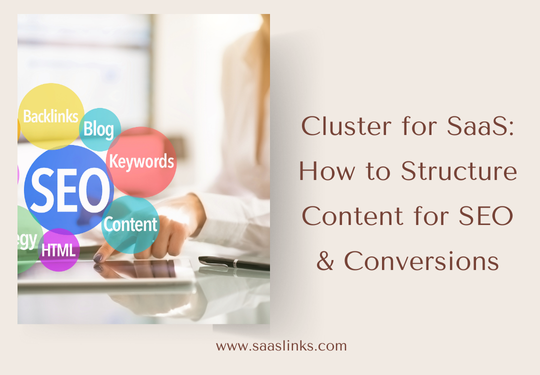
Cluster for SaaS: How to Structure Content for SEO & Conversions
In the competitive arena of Software-as-a-Service, visibility is paramount, and so is conversion. Most SaaS companies are having difficulty converting their blog content into real leads. That is where topic clusters come in. We assist SaaS companies in learning content structure with strategic clusters that enhance SEO performance and trigger real conversions here at SaaSlinks. If you’re prepared to put an end to writing dispersed blog posts and begin creating a sustainable content engine, learning Cluster for SaaS is the answer.
What is a Content Cluster?
A content cluster (or topic gathering information) is a standardized content strategy in which a central “pillar” page aims at a generic topic, and supporting “cluster” pages intend at particular subtopics. These pages link to each other to prove to search engines the semantic relation between topics.
For example, if your SaaS solution has project management features, your pillar page would be “The Ultimate Guide to Project Management for Startups,” and your cluster pages would be “How to Manage Remote Teams,” “Agile vs. Waterfall: What Works Best,” and “Top Features in Project Management Tools.”
This structure not only constructs topical authority but also improves user experience with two of the elements that affect your ranking and conversion rates.
Why Use Cluster for SaaS?
The strategic approach of SaaS Cluster isn’t some SEO hype. It’s a proven framework that enables SaaS businesses to own niche subjects and drive engagements to conversion points such as demos, trials, or sign-ups. Here’s why it works:
1. Better SEO Ranking:
Search engines respect websites that offer comprehensive content around a topic. By connecting to pillar and cluster content, your site signals that topical authority will be enhanced. Google understands that your expertise is improving, and that increases your chances of ranking higher for multiple related keywords.
2. Better User Engagement:
Visitors arrive on your page with Queries. By having your content classified into a cluster, the audience is organically taken through related content. This improves time on site, lowers bounce rate, and takes them more down the funnel.
3. Simplified Content Strategy
With a cluster model, you never have to wonder what to create next. Rather than guessing on what blog post could be successful, you’re working with a full resource. That consistency brings more ROI on your content marketing.
Steps to Organize Content with Cluster for SaaS
Let’s dissect how to actually construct a converting topic cluster:
Step 1: Determine Your Core Pillar Topic:
Begin by selecting an overall, high-purpose topic that is directly related to your SaaS product. Next, use SEO tools to confirm the search volume and keyword difficulty.. Ensure this is something your ideal customer would search for, leading to your tool coming into play.
For instance, if you are a B2B email marketing platform, your pillar topic might be “Email Marketing Strategies for B2B SaaS.”
Step 2: Map Out Subtopics for Clusters:
Once the main topic is clearly defined, divide it into 5-10 subtopics. These will become your cluster pages. These should answer specific questions or focus on narrower aspects of the main topic.
Using the B2B email marketing example, cluster pages might include:
- “Best Cold Email Templates for SaaS”
- “How to Segment Email Lists for Better Conversion”
- “A/B Testing Subject Lines: What SaaS Marketers Need to Know”
- These will all link back to the pillar internally, and vice versa.
Step 3: Develop a Link Strategy:
Merging, or we can say Linking, is the Cluster for SaaS secret sauce. Ensure each cluster page links to the pillar content, and at least 2–3 other applicable cluster pages. This builds up a solid internal link structure that enhances crawlability and makes search engines understand the Ranking.
And don’t forget about external links. Referencing from respected sources lends credibility and can even improve your Probability of attracting backlinks.
Step 4: Optimize for Conversion:
SEO will bring people through the door, but transformative optimization will convert them into leads. Each page within your cluster should include:
- A distinct CTA (call to action)
- Visually attractive imagery or stats to complement the copy
- Case studies or proofs if applicable
- Minimal assortments (streamlined layout, quick loading)
- Cluster pages must direct users logically to conversion activities such as downloading an eBook, scheduling a demo, or initiating a trial.
- Common SaaS Company Cluster Mistakes
A lot of SaaS companies implement the cluster approach, but commit major errors like:
- Creating thin content: Cluster content must be rich in depth and value, not superficial details.
- Overlooking conversion: SEO traffic is unusual without a conversion scheme.
- Forgetting to refresh: Pillar and cluster content will need to be refreshed over time in order to remain relevant.
- Avoid all these, and you’re already ahead of the crowd.
- Measuring Success with Cluster for SaaS
How do I know my clusters are successful? Monitor these KPIs:
- Organic traffics growth to pillar and cluster pages
- Page-to-page user navigation increase
- Direct leads or conversions from blog posts
- Keyword ranking enhancements
- With repeated effort, you should be seeing positive trends in 3–6 months.
Conclusion:
Creating content from the Cluster for SaaS strategy is more than SEO—it’s building a customer journey that converts. Buyers of SaaS need answers, and as your website becomes the authority on those answers, trust (and dollars) to follow. At SaaSlinks, we create high-performing content structures optimized both for search and sales. If you’re ready to go beyond scratchy or uneven blog posts and begin getting qualified leads, it’s time to cluster up and shine.
Beat the Bots: Your Guide to AI Overview Rankings
In the age of digitalization, in which artificial intelligence more and more determines how users locate and consume information, being discoverable online is more than merely ranking on conventional search engines. That’s where SaaSLinks comes in with this exhaustive, no-nonsense guide to assisting you in beat the bots and earning your spot within the influential new world of AI Overview rankings.
Whether you’re a content creator, digital marketer, or SaaS brand looking to grow then understanding about how to optimize for AI-generated summaries which can be the key to unlocking visibility, credibility, and conversions.
* What is an AI Overview?
It is a short, AI-created fragment of data that shows up at the beginning of search results. Google and other websites employ machine learning models to scan across the web for content and create these summaries in an attempt to give users immediate answers.
Imagine it like a “highlight reel” of the web, and it is automatically generated by AI. Overviews tend to aggregate information from various sources, and while that’s great for users, it’s tough on content creators. If your site content isn’t part of these summaries, your traffic could decline even if you rank well in classic search results.
In order to actually beat the bots, you must know how they select material and how to become one of their favorite sources.
* Why AI Overviews Matter for Your SEO Strategy:
Overviews written by AI are no longer an experiment, they’re making their way into the mainstream. Disregarding them might leave your brand falling behind.
Here’s why:
- Fewer Click-Throughs to Classic Results: Users tend to obtain what they require from the Overview itself.
- Authority Creation: When an AI Overview is included in your content then it lends your brand perceived authority.
- Trust Amplification: Being selected by AI conveys that your content is high-quality, accurate, and valuable.
As AI influences play a greater role in search behavior, modifying your strategy for content is necessary so that your content isn’t left behind.
* How to Beat the Bots: 6 Practical Tips
Getting into an AI Overview isn’t trickery about its alignment. Let’s see what makes content shine in the algorithm’s eyes.
1. Organize Content Clearly
AI models are designed to read, comprehend, and summarize quickly. To make your content “AI-friendly”:
- Utilize simple headings (H2, H3) to structure topics
- Keep sentences concise and brief
- Use bullet points or numbered lists wherever possible
Content that is well-standardized is more likely to be taken up in AI summaries.
2. Answer Questions Directly
Since AI Overviews are designed to deliver swift answers, your content should be able to foresee and answer typical user questions directly. Apply:
- FAQs
- Definitions
- “How-to” instructions
- Step-by-step guides
Being the most open and reliable source of truth puts you ahead of the pack in the race to beat the bots.
3. Prioritize Topical Authority
AI systems favor content from sources with a profound understanding. Establish authority through:
- Publishing related content pieces surrounding a central topic
- Linking internally between articles
- Referencing credible sources
“Depth and consistency signal to AI that your content deserves to be summarized.”
4. Always use Natural Language, Not Fully Keyword-Stuffing
Don’t sound like a robot. AI does get context, so write in the way people actually search. Incorporate your keywords, such as AI Overview, and beat the bots naturally.
For instance:
“To boost your chances of being featured in an AI Overview, frame your responses in a manner that is understandable and fact-oriented.”
That’s better than awkward keyword stuffing.
5. Improve your site’s SEO by implementing structured data (schema markup)
Applying schema markup improves how search engines and AI understand your content. Use FAQ, How-To, and Article schema on your pages as much as possible, but only wherever applicable. This small action can increase your chances of being selected by AI systems.
6. Keep your Content Updated and Optimize Performance Regularly
AI prefers new and current content. Go through your best-performing pages again and enhance them:
- Update old facts
- Add new internal links
- Enhance clarity and formatting
It’s a continuous process if you wish to repeatedly show up in AI Overview positions and really outsmart the bots.
* Where SEO Meets AI: The Future is Now
The development of AI in search isn’t something to be feared; it’s a new chance. If your business can catch up quickly, it may actually level the playing field. Small companies and SaaS companies can now compete with big publishers just by providing the most relevant and well-organized content.
For both founders and marketers, knowing AI Overview rankings is the next great move toward sustainable growth. And the earlier the moving brands get, the more attention they will gain.
Conclusion
The landscape of search is evolving quickly, with AI driving the transformation. Your content strategy must change as well. By prioritizing clarity, authority, and the specific requirements of AI algorithms, you can beat the bots and find your spot in top-of-the-fold summaries.
At SaaSLinks, we assist innovative companies with keeping one step ahead. Whether you’re looking to scale traffic, establish authority, or just learn what’s coming next in digital marketing, being ahead of the search curve is not an option.
Smart optimize. Write human. Rank where it counts.
SEO vs GEO: An In-Depth Comparison Guide for Modern Marketers
Among digital marketing strategies, there are two main methodologies that have been brought into the spotlight: SEO (Search Engine Optimization) and GEO (Geolocation Marketing). However, both intended to drive traffic and enhance visibility as they differ drastically in approach, application, and results.
Realizing how SEO vs GEO is crucial for marketers who wish to make strategic, informed choices. This Detailed guide for Modern Marketers compares each method and its benefits, and aids you in selecting which strategy or blend of both works best for your business needs.
What is SEO?
Search Engine Optimization (SEO) is used to improve your website and content, and technical seo services help increase your visibility in search engine results pages (SERPs) for targeted phrases and keywords. It is a blend of on-page (content, meta tags, internal linking) and off-page (backlinks, social signals) methodologies.
Major SEO Components:
- Keyword Research: Choose what search terms people are entering into Google.
- Content Optimization: Evolving useful and keyword-loaded content.
- Technical SEO: Improve site speed, guaranteeing mobile responsiveness, and for better search engine performance, you need to optimize detailed data.
- Backlinks: To increase credibility, develop links from high-authority sites.
Benefits of SEO:
- Growth of Organic traffic in the long term
- Improved authenticity and brand authority
- Budget-friendly in the long term
- Increased for companies marketing their global reach to larger markets
What is GEO (Geolocation Marketing)?
GEO (Geolocation Marketing) is targeting users by their actual location through GPS, IP, or mobile data. GEO enables marketers to push location-based content, promotions, and advertisements to potential customers closely.
Key GEO Components:
- Geofencing: Creating a virtual barrier around an area to send targeted ads when users are in the neighbourhood.
- Beacon Technology: Pushing alerts to mobile phones through Bluetooth near stores or events.
- Localized Advertising: Pushing alerts to smartphones through Bluetooth near stores or events.
Benefits of GEO:
- Actual-time, location-based targeting
- Increased conversion rates for local deals
- Improved customer experience through personalization
- Ideal for offline businesses
SEO vs GEO: What’s the Difference?
Although both strategies focused on improving visibility and engagement, they are designed for different reasons:
| Sr no. | Feature | SEO | GEO |
| 1. | Reach | Global or national | Local or hyper-local |
| 2. | Approach | Keyword & content focused | Location and behavior focused |
| 3. | Tools Used | Google Analytics, SEMrush, Ahrefs | GPS, Beacons, Location-based Ads |
| 4. | Best For | Online businesses, blogs, e-commerce | Local shops, events, service areas |
| 5. | Conversion Speed | Gradual growth over time | Quick results, especially for offers |
If you’re choosing between GEO vs SEO, think about your business model. For online businesses, SEO gives you a wider reach. For local companies, GEO means your ads go to the most likely to respond right away.
Combining SEO and GEO Together: The Smart Approach Strategy
Instead of either/or, many marketers currently use both and combine them for the greatest effect. This is how:
- Local SEO: Here is where SEO intersects with GEO. Localizing your site with geo-based keywords (such as “best coffee shop in Jaipur”) to rank in local search.
- GMB Optimization: Google My Business listings improve local visibility and also help with SEO performance.
- Geo-targeted Content: Develop blog entries or landing pages with geo-targeted content.
- Localized Ads with SEO Landing Pages: Implement GEO-based ads that send users to SEO-optimized pages for improved conversion.
This hybrid strategy supports both discoverability and relevance between the two core pillars of Successful marketing.
FAQs: SEO vs GEO
Q1. May I use both SEO and GEO at the same time?
Ans. Of course. In most cases, using both together is the best idea, particularly for companies with both online and local business.
Q2. Is GEO marketing more expensive than SEO?
Ans. GEO campaigns (such as geofencing advertisements) tend to cost more initially but may produce quick, short-term outcomes. SEO, being slower to deliver outcomes, is economical in the long run.
Q3. Which is better for a service-based local business?
Ans. GEO marketing provides you with instant access to local prospects willing to buy, while local SEO establishes a long-term presence. The best is to have a combination.
Q4. Does SEO help with mobile users like GEO does?
Ans. Yes. With mobile-first indexing and local SEO strategies, SEO can be highly effective for reaching mobile users. But GEO provides greater accuracy in location-targeted mobile marketing.
Conclusion
In today’s digital age, it is imperative to know the dynamics of SEO vs GEO for astute marketing. SEO emphasizes long-term development through organic visibility, whereas GEO utilizes real-time location to drive instant engagement.
As we’ve discussed throughout this comprehensive, detailed guide for Modern Marketers, the choice isn’t so much one against the other but how to combine both for better, more applicable marketing. If you’re operating an international e-commerce business or a small boutique shop, tapping into the capabilities of each methodology can deliver outstanding results.
Tip!
Begin by auditing your current digital marketing strategy. Identify whether your goals are to attract, convert, or retain, and let that dictate how much SEO or GEO you invest in.

Top 15 SaaS SEO Agencies in 2026
SaaS delivers software apps online and allowing users to access and use them without worrying about the underlying infrastructure or maintenance. Examples include email services, customer relationship management (CRM) systems, and office productivity tools etc.
Having the correct SEO partner is a game-changer for SaaS companies in 2026. The internet is more competitive than ever before, and businesses are looking for experienced SEO agencies for SaaS, which stands for Software-as-a-Service marketing inside out. If you need effective SEO strategies, you need to hire an expert SEO consultant for SaaS or an agency offering full-service, which is SaaSLinks. Regardless of whether you are a growth SaaS business or a startup SaaS brand, this top 15-rated seo agencies for saas, along with five to watch agencies, is your guide to long-term success.
We have shortlisted this list based on performance, client feedback, SaaS experience, innovation, and case studies to assist you in selecting the best SEO agency for SaaS that suits your growth strategy.
1. SaaSLinks.io:
Location: Darwin, Australia
Best For: Results-Oriented SEO and content strategy for SaaS
This is a best-of-class performer in 2026 by one of the top 10 rated SEO agencies for SaaS. Their optimized strategy combines cutting-edge keyword research, technical SEO, and conversion-driven content marketing. With an acute understanding of SaaS buyer journeys, UniqDomain produces real results through scalable organic strategies. They provide it all, from backlink building to CRO, making them a full-service SEO agency for SaaS companies pursuing aggressive growth.
2. Omniscient Digital:
HQ: Remote (USA)
Best For: SaaS strategic content SEO
The agency is operated by former Shopify and HubSpot marketers. Omniscient Digital assists SaaS brands in taking ownership of organic traffic through pillar content, internal linking strategies, and scalable SEO audits.
3. Directive:
Location: Irvine, CA
Best For: Enterprise SaaS SEO
Instruction is an SEO agency with a strong capability in SaaS. Directive’s SEO team uses a proprietary Customer Generation approach to generate MQLs and SQLs, rather than traffic. They are usually part of the best saas seo agencies, delivering SEO, PPC, and CRO together.
4. Single Grain:
Location: Los Angeles, CA
Best For: Growth-driven SEO and paid media
Headed by Eric Siu, Single Grain has been a steady player in the SaaS marketing industry. Their end-to-end strategies blend organic and paid to bring ROI. For companies aiming to scale up fast, this SaaS SEO agency is a perfect fit.
5. Kalungi:
Address: Seattle, WA
Best For: Early-stage SaaS businesses
Kalungi is a B2B SaaS-only full-stack marketing agency. They provide fractional CMOs, who include SEO consultants for SaaS, to lead go-to-market strategies. Their SEO service starts with building solid foundations through technical audits, keyword planning, and content creation.
6. GrowthRamp:
Location: Remote
Best For: Positioning and organic SEO growth
GrowthRamp assists SaaS startups in establishing their brand and search visibility. They are experts in customer research, positioning, and organic content that converts. Their consultants have knowledge of SaaS buyer behavior, and hence they are a trusted SEO consultant for SaaS teams.
7. KlientBoost:
Headquarters: Costa Mesa, CA
Best For: SaaS PPC + SEO combinations
While KlientBoost began in PPC, its SEO practice is just as strong. They possess a couple of SaaS brands with data-driven SEO roadmaps. Conversion-driven in nature, they are a good selection among the best saas seo agencies.
8. Codeless:
Headquarters: New York, NY
Best For: Content-driven SEO for SaaS
Codeless creates high-quality, SEO-optimized long-form content that ranks and converts. Major SaaS brands are included in their portfolio. As a supreme SaaS SEO agency, without coding is best for businesses looking to scale content marketing.
9. Accelerate Agency:
Location: UK & USA
Best For: Technical SEO and analytics
Accelerate Agency, which provides technical SEO services to B2B and SaaS companies only. They have data scientists who translate insights into action at scale. If you need an elite SaaS SEO agency with in-depth technical knowledge, then this agency is the one to go for.
10. Tuff Growth:
Location: Denver, CO
Best For: Early-stage SaaS SEO
Tuff Growth works closely with SaaS startups to generate traffic and leads by implementing hands-on SEO strategies. Their growth marketing team functions as an extension of your in-house team, which makes them an ideal choice for lean teams in need of flexible support from an SEO consultant for SaaS.
11. Growfusely:
Location: India (Remote)
Best For: Global SaaS SEO
Growfusely is a SaaS SEO and agency of content marketing that enables brands to grow worldwide. Its cost-effective price and global experience make it the preferred agency for mid-market SaaS businesses and startups.
12. Siege Media:
Location: Austin, TX
Best For: Link building and content quality
Siege Media is renowned for its excellent content marketing abilities, alongside its SEO capabilities. Their SaaS clients have posted outstanding traffic and authority improvements through strategically aimed campaigns. If you seek an innovative SaaS SEO consultant, Siege Media stands as a prime contender.
13. InboundLabs:
Location: Global
Best For: HubSpot-integrated SEO in SaaS
For SaaS companies that are using HubSpot, InboundLabs is an appropriate blend of inbound marketing, CRM support, and SEO. Their campaigns are ROI-driven and performance-driven, ideal for analytical SaaS marketers.
14. Skale:
Location: Barcelona, Spain
Best For: ARR-focused in SaaS SEO
Skale’s team exclusively works with SaaS businesses, creating tailored SEO strategies that have a direct impact on monthly recurring revenue (MRR). Their growth experiments and ROI tracking abilities make them one of the more innovative SaaS SEO agencies
.
15. Titan Growth:
Location: San Diego, CA
Best For: Enterprise SaaS brands
Titan Growth leverages proprietary TitanBOT® technology to enact and refine SEO tactics before Google even crawls your site. Their technology-driven strategy is perfect for high-traffic SaaS businesses seeking a competitive advantage.
Final Thoughts
Selecting the optimal SEO agency for SaaS is no longer about rankings–it’s about qualified lead acquisition, retention, and revenue increase. If what you’re looking for is a full-service agency like SaaSLinks or an SaaS SEO specialist consultant, no deficiencies can be found in expert agencies that can assist you with growing in 2026.
This thoroughly researched list of the Top 15 rated seo agencies for saas (with five bonus newcomers) should hopefully provide you with the guidance you require in finding the ideal partner for the organic growth journey of your brand.
