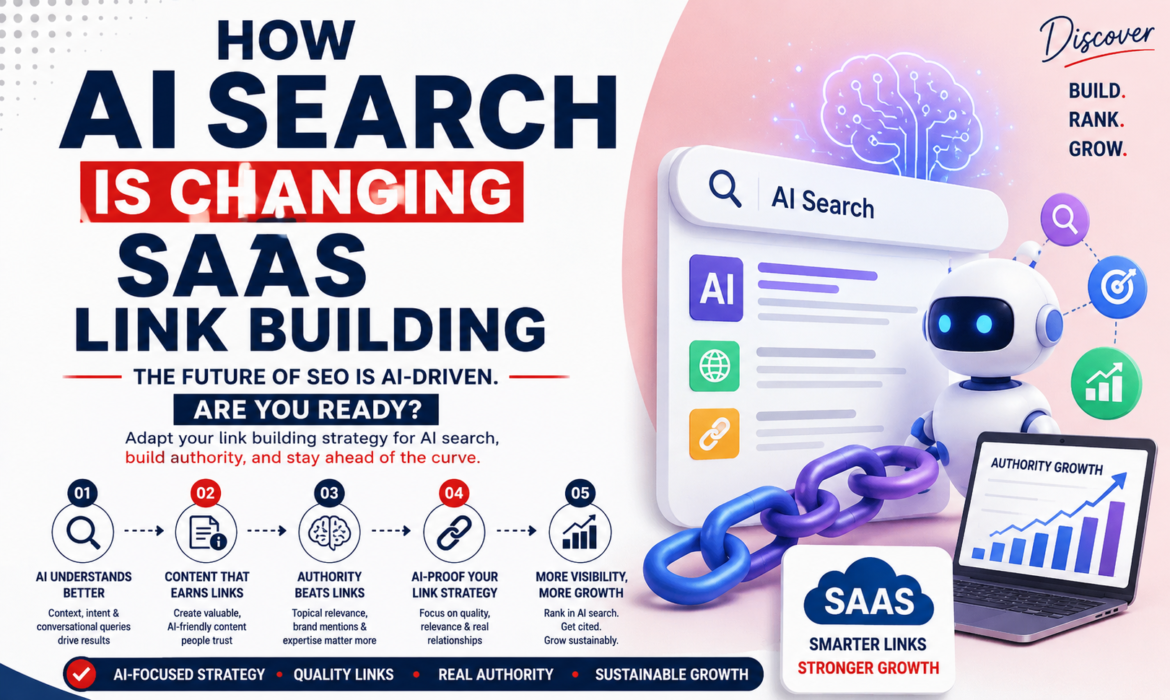
How AI Search Is Changing SaaS Link Building in 2026
Search engines are changing faster and becoming more powerful than ever before. A few years ago, ranking on Google was all about targeting keywords, building backlinks and publishing blog content regularly. But now, AI powered search is shifting the concept of how people find information online. Tools like Google AI Overviews, ChatGPT, Perplexity, Gemini and other AI driven search systems are becoming a major part of how users search for answers. Instead of scrolling through ten blue links, users now get direct answers that AI generates as soon as the user puts the query on search engine.
This move is creating a completely new future for SaaS marketing, particularly when it comes to link building. In this blog, we will investigate how AI search is changing SaaS link building, why AI citations are becoming important and how GEO for SaaS and AEO for SaaS are shaping the future of SEO.
The Rise of AI Search for SaaS
AI search for SaaS is becoming one of the biggest shifts in digital marketing. This means SaaS companies need smarter strategies to stay visible online. Old backlink methods still count but they are no longer enough on their own because they need some add on that can fit into Modern AI search methods. AI search engines are paying more attention to authority, trust, citations, expertise and contextual relevance. Rather than showing only website links, AI search tools now summarize information from multiple sources and deliver direct responses to users.
AI generates the answers using data that it collects from websites, articles, forums, reviews and trusted online sources. For SaaS companies, this changes how visibility works. In traditional SEO, ranking on frist page was the goal, but in AI powered search, getting visibility in the AI generated answer is becoming even more crucial. For example, when someone searches:
- “Best CRM software for startups”
- “Top project management tools”
- “Best email automation SaaS”
AI search engines may deliver a brief answer without users even clicking on websites. That means SaaS brands now compete not just for rankings but also for mentions and citations inside AI generated results. This is where modern link building becomes critical. .
Read Also: Best Outreach Tools for SaaS Link Building Campaigns
Why Traditional Link Building Is No Longer Enough
For years, SaaS companies aim was to produce a heavy backlink quantity. The strategy was straightforward: Get as many links as possible from blogs, directories, guest posts and outreach campaigns. While backlinks still help with authority but AI search engines are becoming smarter about understanding context and trust. They now analyze:
- Brand mentions
- Author expertise
- Context around links
- Topic relevance
- User engagement
- Source trustworthiness
- Citation consistency
A random backlink from a low quality website no longer gives the same value it once did. AI systems care more about whether your SaaS brand is genuinely trustworthy across the web. This means SaaS link building is moving away from spammy tactics and toward authority driven digital visibility.
Why AI Citations Are Becoming the New Backlinks?
The notable changes happening right now are the rise of AI citations. AI tools usually collect information from trustworthy websites and cite them when generating answers. These citations work similarly to references. If your SaaS brand is repeatedly showing across authoritative sources, AI models are more likely to trust your content and will include your site link when it generates answers. This is why AI citations are becoming extremely valuable. Apart from traditional backlinks, citations do not always need clickable links. Even unlinked mentions from trusted websites can help improve brand visibility in AI search systems. For SaaS companies, this means building authority across multiple platforms matters more than ever. Some strong citation sources are:
- Industry blogs
- SaaS review platforms
- News publications
- Research reports
- Podcasts
- Expert interviews
- Community discussions
- Technical documentation
- LinkedIn articles
The goal is no longer just “getting backlinks.” The goal is to become a popular authority that AI systems consistently trust.
How AI Search Changes Content Strategy
Content creation is also developing because of AI search. In the past, many SaaS companies made content mainly for keywords. Articles were usually loaded with search terms to improve rankings. Now, AI systems prioritize content that actually answers user intent clearly and naturally. This means content needs to be:
- Helpful
- Conversational
- Accurate
- Easy to understand
- Well-structured
- Trustworthy
- Experience-based
AI search engines are very good at identifying shallow content. If your article repeats basic information without offering unique value, it becomes less useful for AI generated summaries. SaaS companies now need content that shows expertise and real world understanding.
For example: instead of writing:
“Best CRM software in 2026”
A better approach you can use is:
“How startups use CRM software to improve sales automation”
This creates deeper contextual relevance that AI systems prefer.
GEO for SaaS Is Becoming Important
One of the newest concepts gaining attention is GEO for SaaS. GEO stands for Generative Engine Optimization. It pays attention to optimizing content so that AI engines can easily understand, trust and use it in generating responses. Traditional SEO was made mainly for search engine rankings. GEO for SaaS focuses on visibility inside AI generated answers.
This includes:
- Structuring content clearly
- Using factual information
- Adding expert insights
- Building topical authority
- Earning trustworthy mentions
- Improving semantic relevance
Generative AI tools prefer content that sounds natural and informative. They also prioritize websites with strong credibility signals. For SaaS brands, GEO means producing content that helps AI systems confidently use your information when answering users. This is becoming one of the most important strategies in future focused SaaS marketing.
AEO for SaaS and the Shift Toward Answer-Based Search
Another important trend is AEO for SaaS, which is gaining popularity nowadays. AEO stands for Answer Engine Optimization. Rather than optimizing only for search engines, brands now optimize for answer engines. This matters because users increasingly ask conversational questions like:
- “What is the best accounting software for freelancers?”
- “Which SaaS tool helps automate customer support?”
- “What’s the easiest project management software for small teams?”
AI tools directly give responses to these questions. To get success with AEO for SaaS, content should answer questions clearly and directly. Good AEO content usually comes with:
- Clear headings
- Direct answers
- FAQ sections
- Natural language
- Short explanations
- Practical examples
This improves the chances of being chosen by AI systems when generating responses. The brands that deliver the clearest and most useful answers are more likely to gain visibility.
Authority Is the New Currency
In AI search, authority matters more than ever. AI systems evaluate whether your SaaS brand is trustworthy enough to include in generated answers. This means reputation building is becoming a central part of link building. Some of the best ways SaaS companies can build authority include:
Publishing Original Research
Unique data and reports are highly valuable because other websites naturally reference them.
Getting Featured on Trusted Websites
Mentions from reputable industry sites help to make good credibility among users.
Building Thought Leadership
Founders and professionals sharing insights on LinkedIn, podcasts, webinars and interviews can boost brand trust.
Creating High Value Educational Content
Guides, tutorials and case studies help position SaaS companies as experts.
Encouraging Reviews and Discussions
User generated conversations help create broader digital visibility.
AI systems notice when a brand is consistently discussed positively across the internet.
Why Context Matters More Than Link Quantity
One of the biggest changes in modern SaaS link building is the importance of context. A contextual mention from a highly relevant article is now likely to be more powerful than dozens of irrelevant backlinks.
For example:
A project management SaaS said in a detailed article that remote team productivity is highly relevant. AI systems understand this relationship. This means SaaS marketers should watch on:
- Relevance
- Topic alignment
- Industry authority
- Natural placements
Mass outreach campaigns with generic guest posts are becoming less useful. Quality and context now matter far more than volume.
The Role of EEAT in AI Search
Google and AI systems increasingly rely on EEAT:
- Experience
- Expertise
- Authoritativeness
- Trustworthiness
This framework helps AI select which content deserves visibility. SaaS brands should show real expertise through:
- Expert written content
- Case studies
- Product insights
- Customer experiences
- Accurate information
- Transparent authorship
AI search engines reward websites that show genuine knowledge. This is particularly critical in competitive SaaS industries where many companies publish similar content.
The Future of SaaS Link Building
SaaS link building is not disappearing, it is developing by the time. The future will settle less on manipulation and more on genuine authority building. Successful SaaS companies will likely invest more in:
- Digital PR
- Expert content
- Brand mentions
- AI citations
- Community engagement
- Research based content
- Trust signals
- Conversational optimization
The brands that become trusted information sources will perform better in AI powered search environments. This shift is actually positive for users because it encourages better content quality across the web.
Conclusion
AI powered search is changing the entire digital marketing geography. Old SEO strategies still have their place but SaaS companies now need to think beyond rankings and backlinks. AI search for SaaS is pushing brands toward authority, trust, relevance and meaningful visibility across the internet. Concepts like AI citations, GEO for SaaS and AEO for SaaS are becoming essential parts of modern growth strategies.
The future of SaaS link building belongs to companies that create genuinely helpful content, earn trustworthy mentions and become popular experts in their industry. Brands that adapt early to AI driven search behavior will have a stronger chance of staying visible as search continues to develop. Companies like SaaS links are already recognizing how important this shift is for long term SaaS growth.
FAQs
What is AI search for SaaS?
AI search for SaaS refers to AI-powered search systems that generate answers using information that it collects from various online sources instead of only showing old search results.
What are AI citations?
AI citations are references or mentions used by AI systems when generating responses. These citations help AI tools recognize trustworthy and authoritative content sources.
What is GEO for SaaS?
GEO for SaaS stands for Generative Engine Optimization. It focuses on optimizing content for AI generated search experiences rather than only traditional search rankings.
What is AEO for SaaS?
AEO for SaaS means Answer Engine Optimization. It helps SaaS brands make content that instantly answers user questions clearly and naturally.
Is link building still important in AI search?
Yes, link building still has its worth, but the priority is shifting toward authority, trust, contextual relevance and high-quality brand mentions instead of simply getting large numbers of backlinks.
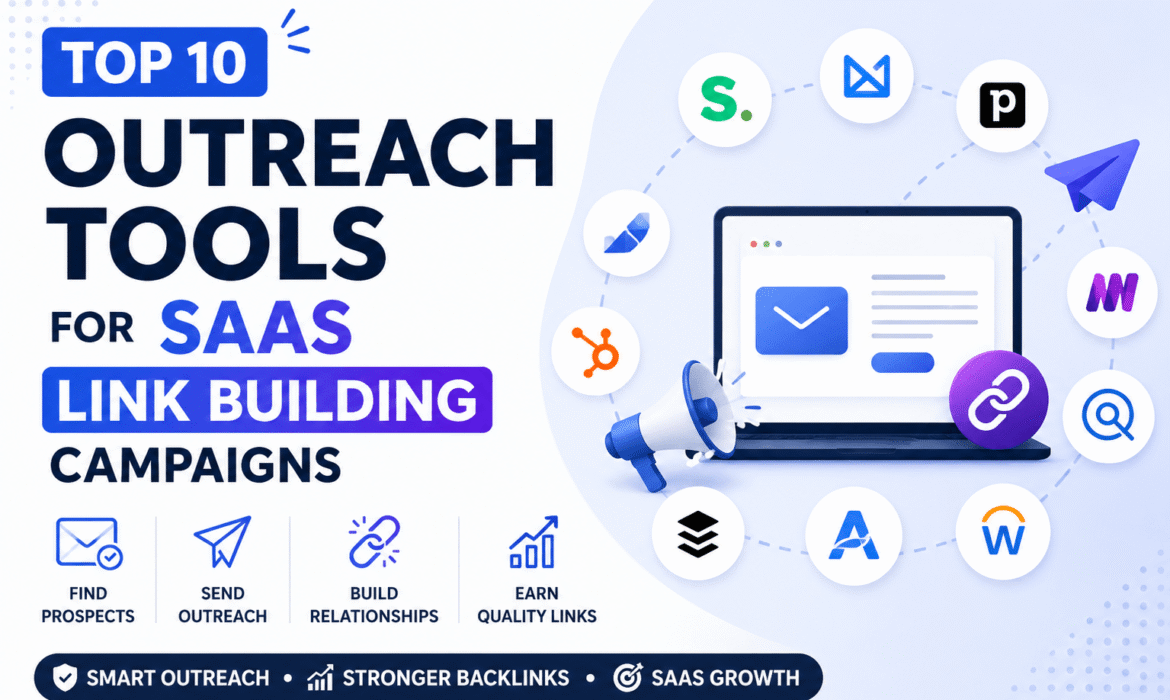
Best Outreach Tools for SaaS Link Building Campaigns in 2026
Link building outreach is a process problem as much as it is a strategy problem. You can have a perfect prospect list, a compelling pitch angle, and genuinely link-worthy content, but without the right tools for managing your pipeline, follow-ups, contact data, and email deliverability, that work falls apart in execution.
The outreach tool landscape in 2026 is more developed than it’s ever been, which also means it’s more confusing. There are purpose-built outreach CRMs, email finders, cold email sending platforms, deliverability tools, and AI-assisted personalisation layers, all competing for a spot in your stack. Not every SaaS team needs all of them, and buying the wrong tool at the wrong stage wastes both budget and time.
This guide breaks down every category of outreach tool relevant to SaaS link building, with honest assessments of which tools are worth using, at what scale, and at what cost. Pricing figures are current as of 2026.
What this guide covers:
- Outreach CRMs: managing relationships and campaign pipelines
- Email finder tools: building verified contact lists
- Cold email sending platforms: deliverability and sequencing
- Follow-up automation: converting prospects who don’t reply first time
- Email verification: protecting sender reputation
- Link monitoring: tracking what you’ve placed
- A decision framework for choosing your stack by growth stage
Outreach CRMs: The Core of Any Serious Link Building Campaign
An outreach CRM is the operational backbone of a link-building campaign. It stores your prospect list, tracks which emails have been sent, logs replies, schedules follow-ups, and prevents two team members from accidentally contacting the same editor about the same campaign. Without one, link building at any meaningful scale becomes unmanageable.
There are three tools that dominate this category in 2026, each suited to a different stage of growth.
BuzzStream: Best for Small Teams and Relationship-Focused Outreach
BuzzStream is the most widely used outreach CRM for link building, and for good reason. It’s purpose-built for the specific workflow of link acquisition: you collect prospects, pull in their contact details, evaluate domain metrics, write personalised outreach, schedule follow-ups, and track when links go live. Everything stays in one searchable database.
What sets BuzzStream apart is its relationship tracking. It logs every interaction with a contact across your team, which prevents the embarrassing situation of two people emailing the same editor about different campaigns. For small teams doing relationship-based outreach, that visibility is worth more than any automation feature.
Pricing:
- Starter: $24/month (1 user, 1,000 contacts)
- Growth: $124/month (3 users, 25,000 contacts)
- Professional: $299/month (6 users, 100,000 contacts)
The honest limitation: The 1,000-contact cap on Starter forces an upgrade faster than most people expect. Once you’re building systematic prospect lists, you’ll hit it within a month or two. Budget for the Growth plan from the start if you’re running regular campaigns.
Best for: Solo link builders, two to three-person SEO teams, and anyone doing digital PR or journalist pitching where relationship history matters more than automation depth.
Pitchbox: Best for Agencies and High-Volume Campaigns
Pitchbox is what BuzzStream becomes when link building stops being a task and turns into an operation. It’s built for teams running multiple campaigns simultaneously, with conditional automation sequences, workspace separation for different clients, and native integrations with Ahrefs, Moz, and other SEO tools for real-time prospect scoring.
The automation depth is the key differentiator. Pitchbox can run follow-up sequences that trigger based on specific conditions: if a prospect opens but doesn’t reply, send a different follow-up than if they didn’t open at all. That level of conditional logic isn’t available in BuzzStream, and it meaningfully improves conversion rates on high-volume campaigns.
Pricing:
- Pro: $165/month (2 users, 2,000 outreach emails/month, 50,000 contacts)
- Advanced: $420/month (unlimited users, 25 workspaces)
- Scale: $675/month (15,000 outreach emails/month, highest limits)
The honest limitation: Pitchbox Pro’s 600,000 annual data credits run out faster than the pricing page suggests for teams doing heavy prospecting. Most agencies doing real volume need the Advanced plan at $420/month minimum. The Pro plan is too constrained for genuine agency-scale work.
Best for: Agencies managing five or more client campaigns simultaneously, in-house SEO teams running multiple concurrent campaigns, and anyone who needs white-label reporting for stakeholders.
Respona: Best for Content-Driven Outreach and Guided Workflows
Respona occupies the middle ground between BuzzStream and Pitchbox. It connects directly to Google Search to find relevant content, pulls contact data automatically, and includes AI-assisted personalisation that suggests how to reference a prospect’s recent work in your pitch.
Where Respona genuinely stands out is its template library. It ships with pre-built campaign workflows for guest posting, broken link building, resource page outreach, podcast pitching, and digital PR. For SaaS teams new to structured outreach, those templates lower the learning curve significantly. You can run your first campaign within a couple of hours of signing up.
Pricing: From $99/month (entry tier), with most active campaign users on the $198/month plan.
The honest limitation: Respona’s prospect database depth trails the larger platforms. For niche SaaS categories, you may need to supplement with manual prospecting or Ahrefs exports rather than relying solely on Respona’s built-in discovery.
Best for: SaaS companies and small agencies that want prospecting and sending under one roof, content marketers who find BuzzStream too manual, and teams running their first structured outreach campaigns.
Outreach CRM Comparison
| Tool | Starting Price | Best For | Contact Limit (Entry) | Team Size |
|---|---|---|---|---|
| BuzzStream | $24/month | Relationship-focused outreach | 1,000 | 1 user |
| Pitchbox | $165/month | Agency-scale, multi-campaign | 50,000 | 2 users |
| Respona | $99/month | Guided workflows, content outreach | Varies | 1-2 users |
The bottom line: A $24/month BuzzStream account with a clean, verified prospect list will outperform a $675/month Pitchbox setup sending to unverified contacts. The tool matters, but the quality of your list and the personalisation of your pitch matter more.
Email Finder Tools: Building Verified Contact Lists
Finding the right person’s email address at a target publication is often the biggest bottleneck in link-building outreach. A pitch sent to a generic contact form converts at a fraction of the rate of one sent directly to an editor or content manager. Email finder tools solve this, but they vary significantly in accuracy, coverage, and price.
Hunter.io: The Industry Standard
Hunter.io remains the most widely used email finder for link-building outreach. Enter a domain, and Hunter returns associated email addresses with confidence scores, the most common email format for that domain, and verification status.
Free plan: 25 searches and 50 verifications per month. Sufficient for a focused outreach list of 20 to 25 prospects.
Paid plans: From $49/month for 500 searches. The Starter plan covers most in-house SaaS teams running monthly campaigns.
What Hunter does well: Its domain search feature is particularly useful. If you can’t find a specific contact’s email, Hunter shows you the email format the company uses (firstname.lastname@domain.com, for example), which lets you construct a high-confidence email even without a direct match.
Where it falls short: Coverage is weaker for smaller publications and personal blogs. For niche SaaS industry sites with small editorial teams, Hunter often returns no results or low-confidence guesses.
Snov.io: Best for Volume Prospecting
Snov.io combines email finding, verification, and basic outreach sequencing in one platform. For teams that want a single tool to handle contact discovery and initial outreach without a separate CRM, it’s a practical option.
Free plan: 150 credits per month (credits are shared between searches and verifications).
Paid plans: From $39/month for 1,000 credits. The platform scales well for teams sending higher volumes.
What Snov.io does well: Its LinkedIn integration is stronger than Hunter’s, allowing you to find emails directly from LinkedIn profiles using the Snov.io Chrome extension. For SaaS outreach where many targets are active on LinkedIn, this is a meaningful advantage.
Where it falls short: The built-in outreach sequencing is functional but less polished than dedicated CRMs. Teams running sophisticated campaigns typically use Snov.io for contact discovery and then move prospects into BuzzStream or Respona for campaign management.
Voila Norbert: Best Backup Tool
Voila Norbert is best used as a supplementary tool when Hunter and Snov.io draw blanks. Enter a first name, last name, and company domain, and Norbert returns a verified email address with a confidence score.
Free trial: 50 searches with a new account, no credit card required.
Paid plans: From $49/month for 1,000 leads.
The practical approach: Run Hunter first. For any prospect where Hunter returns no result or a low confidence score, run Voila Norbert as a second check. Between the two, you’ll cover the majority of outreach targets.
Email Finder Comparison
| Tool | Free Tier | Paid Entry | Best For | LinkedIn Integration |
|---|---|---|---|---|
| Hunter.io | 25 searches/month | $49/month | Standard outreach, domain search | Basic |
| Snov.io | 150 credits/month | $39/month | Volume prospecting, LinkedIn targets | Strong |
| Voila Norbert | 50 searches (trial) | $49/month | Backup for missed contacts | None |
Cold Email Sending Platforms: Deliverability and Sequencing
Your outreach CRM manages the relationship and pipeline. Your email sending platform handles the actual mechanics of getting emails delivered, opened, and responded to. These are distinct functions, and for teams running campaigns at volume, treating them as separate concerns is important.
Deliverability is the most underappreciated factor in link-building outreach. A campaign sending 200 emails per month from a properly warmed-up domain with a clean sending reputation will consistently outperform one sending 2,000 emails from a domain that’s been flagged as spammy. Inbox placement rates matter more than send volume.
Instantly.ai: Best for Cold Email at Scale
Instantly.ai has become one of the most widely used cold email platforms for link building in 2026, particularly for teams running high-volume campaigns across multiple domains and inboxes.
What makes Instantly valuable for link building:
- Unlimited email accounts on paid plans (critical for warming up multiple domains)
- Built-in email warmup that automatically sends and replies to emails to establish sender reputation
- Smart sending schedules that randomise send times to mimic human behaviour
- Campaign analytics showing open rates, reply rates, and bounce rates per sequence
Pricing: From $37/month (Growth) for unlimited email accounts and 1,000 active leads. The $97/month Hypergrowth plan removes most limits and is where most active campaign users land.
The honest limitation: Instantly is a cold email platform, not a link building CRM. It doesn’t track relationship history, manage prospect research, or monitor placed links. Most teams use it alongside BuzzStream or Respona rather than instead of them.
Mailshake: Best for Simpler Campaign Workflows
Mailshake is a cleaner, more opinionated cold email tool that combines email sequencing with basic prospecting and LinkedIn outreach in one interface. It’s less powerful than Instantly for high-volume sending but significantly easier to set up and manage for teams running straightforward campaigns.
Pricing: From $29/month per user (Data Finder plan). The Email Outreach plan at $59/month per user adds advanced sequences and A/B testing.
Best for: SaaS teams running 50 to 200 outreach emails per month who want a single tool for sequences without the complexity of a full cold email infrastructure.
Lemlist: Best for Personalisation at Scale
Lemlist differentiates itself through personalisation features: it can dynamically insert custom images, screenshots, and personalised variables into emails at scale. For link building outreach where personalisation is a key conversion driver, this capability is genuinely useful.
Pricing: From $39/month (Email Outreach) to $159/month (Multichannel Expert, which adds LinkedIn and phone steps).
What to know: Lemlist’s personalisation features work best when you have a clear, repeatable outreach angle. For campaigns where every pitch is highly customised (like digital PR), the dynamic personalisation adds less value than for campaigns with a consistent template structure.
Cold Email Platform Comparison
| Tool | Starting Price | Email Accounts | Warmup Included | Best For |
|---|---|---|---|---|
| Instantly.ai | $37/month | Unlimited | Yes | High-volume, multi-domain campaigns |
| Mailshake | $29/user/month | Per account | No | Simple sequences, small teams |
| Lemlist | $39/month | Multiple | Yes | Personalised outreach at scale |
Email Verification: Protecting Your Sender Reputation
Sending outreach emails to invalid or inactive addresses damages your sender reputation and reduces inbox placement rates across all your campaigns. Email verification should happen before any email is sent, not after you’ve already taken the deliverability hit from bounces.
Most email finders include basic verification, but dedicated verification tools are more thorough and worth using before any bulk send.
NeverBounce
NeverBounce is one of the most widely used standalone email verification services. Upload a list of email addresses and it returns a verification status for each one: valid, invalid, catch-all, or unknown.
Pricing: Pay-as-you-go from $0.008 per email (approximately $8 per 1,000 emails). Monthly plans start at $10/month for 1,000 verifications.
What catch-all means: A catch-all domain accepts emails sent to any address at that domain, even invalid ones. This means NeverBounce can’t confirm whether a specific catch-all email is deliverable. For catch-all results, proceed with caution and limit your send volume to that domain.
ZeroBounce
ZeroBounce provides similar verification functionality to NeverBounce with the addition of an email activity score, which estimates how recently an address was used. For link building outreach, the activity score helps you prioritise contacts who are actively checking their inbox over dormant addresses.
Pricing: From $18/month for 2,000 validations, or pay-as-you-go at $0.009 per email.
The practical rule: Verify any list of more than 50 contacts before sending. A bounce rate above 2% on a campaign will trigger spam filters with most email providers. Keeping bounces below 1% is the target for maintaining healthy deliverability.
Key insight: Email verification is cheap insurance. Spending $10 to verify 1,000 contacts before a campaign is a fraction of the cost of rebuilding sender reputation after a high-bounce send damages your domain’s deliverability.
Link Monitoring: Tracking Placements After They Go Live
Earning a link is only half the job. Links can disappear when sites are redesigned, delete articles, or remove external references without notice. Monitoring your placed links ensures you catch losses quickly and can take action before they affect rankings.
Ahrefs Webmaster Tools (Free)
Ahrefs Webmaster Tools is the most practical free option for link monitoring. Set up backlink alerts for your domain, and you’ll receive notifications when new links are discovered or when existing links disappear. For teams not running dedicated link monitoring software, AWT covers the core use case at no cost.
What it monitors: New referring domains, lost referring domains, and changes in your overall backlink profile. The alert frequency can be set to weekly or daily, depending on how actively you want to track changes.
LinkChecker Pro and Dedicated Monitoring Tools
For teams that have placed a large number of links and need granular monitoring, dedicated link monitoring tools check each placed link on a regular schedule and alert you when a link changes status (from dofollow to nofollow, from live to 404, or from indexed to removed).
Monitor Backlinks and LinkChecker are two options in this category. Both offer paid plans starting at around $25 to $30 per month.
The practical approach for most SaaS teams: Use Ahrefs Webmaster Tools for baseline monitoring and maintain a manual tracking sheet in Google Sheets, logging every placed link with its live URL, placement date, and last verification date. Review this sheet monthly and spot-check links that haven’t been verified recently.
What to Do When a Link Disappears
When a placed link goes offline, the response depends on the reason:
- The linking page was deleted: Contact the editor and ask if the content was moved or if they’d be willing to place the link in a related article.
- The link was removed without the page being deleted: This sometimes happens when sites update their content. A polite follow-up noting that the link appears to have been removed is appropriate.
- The entire site went offline: The link equity is lost. Add a similar site to your outreach pipeline as a replacement target.
Response rate on link reclamation outreach is typically higher than cold outreach because you have an existing relationship with the publication. A brief, factual email noting the link appears to have been removed converts at 30 to 50% in most cases.
What Actually Drives Outreach Conversion Rates
Tools handle the mechanics. Conversion rates are determined by the inputs you put into those tools. Before investing in a more expensive outreach platform, it’s worth understanding which factors actually move reply rates and placement rates in SaaS link building.
Personalisation Depth
Generic outreach templates convert at 1 to 3% in most SaaS niches. Personalised outreach that references the recipient’s recent content, mentions a specific article they wrote, or connects the pitch to something they’ve published recently converts at 8 to 15% or higher.
The tools that help most here are the ones that make personalisation faster without making it feel automated. Respona’s AI personalisation suggestions and BuzzStream’s contact notes both serve this function.
Follow-Up Timing and Frequency
Most link placements happen on the second or third email, not the first. A single outreach email with no follow-up is one of the most common reasons link-building campaigns underperform.
A practical follow-up sequence for SaaS link building:
- Initial pitch (day 1)
- First follow-up: brief, adds a new angle or resource (day 5 to 7)
- Second follow-up: short, friendly, gives an easy out (day 12 to 14)
- Final follow-up: closes the loop (day 21 to 28)
Three to four touches is the standard. Beyond four emails to a non-responsive prospect, you’re more likely to damage your sender reputation than earn a link.
Prospect List Quality
The single biggest lever on outreach performance is the quality of your prospect list. Sending 50 highly targeted, verified emails to relevant publications outperforms sending 500 emails to a generic list every time.
Quality signals to filter for before outreach:
- Domain Authority or Domain Rating above your minimum threshold (typically DR 40+)
- Organic traffic above 1,000 monthly visitors (confirms the site is active and indexed)
- Published content in your specific niche in the past 90 days (confirms editorial activity)
- A named editor or content manager you can address by name
Subject Line Performance
Subject lines in link-building outreach follow different patterns than sales emails. The highest-converting subject lines for link acquisition tend to be:
- Specific and reference the recipient’s content: “Your guide to [topic] + a quick note.”
- Short and curiosity-driven: “Quick question about [their site]”
- Honest about the intent without being transactional: “Thought this might fit your [topic] content.”
Avoid subject lines that look like marketing emails (all caps, excessive punctuation, “collaboration opportunity”). Editors receive hundreds of these and filter them aggressively.
Choosing Your Stack by Growth Stage
The right outreach tool stack depends on where your SaaS company is in its link-building journey. Overspending on tooling before you have a repeatable process wastes budget. Underspending creates manual bottlenecks that slow your output.
Here’s how to think about tooling at each stage:
Early Stage: Under 20 Outreach Emails Per Month
At this volume, you don’t need a dedicated outreach CRM. A well-structured Google Sheet handles pipeline management, and the free tiers of Hunter.io and Ahrefs Webmaster Tools cover contact finding and link monitoring.
Recommended stack:
- Google Sheets (pipeline management, free)
- Hunter.io free tier (25 contact searches/month)
- Ahrefs Webmaster Tools (link monitoring, free)
- Gmail or Outlook (email sending, free)
- Google Alerts (brand mention monitoring, free)
Monthly tool cost: $0
Growth Stage: 20 to 100 Outreach Emails Per Month
At this volume, manual tracking becomes a bottleneck, and a proper CRM pays for itself in time saved. This is where BuzzStream or Respona becomes worthwhile.
Recommended stack:
- BuzzStream Growth ($124/month) or Respona ($99/month)
- Hunter.io Starter ($49/month)
- NeverBounce pay-as-you-go ($8 per 1,000 verifications)
- Ahrefs Webmaster Tools (link monitoring, free)
Monthly tool cost: $130 to $180
Scale Stage: 100+ Outreach Emails Per Month
At this volume, deliverability becomes a critical concern, and a dedicated sending platform is worth adding to the stack. Pitchbox becomes relevant if you’re managing multiple campaigns or clients simultaneously.
Recommended stack:
- BuzzStream Professional ($299/month) or Pitchbox Advanced ($420/month)
- Hunter.io Growth ($149/month) or Snov.io Pro ($79/month)
- Instantly.ai Hypergrowth ($97/month) for sending infrastructure
- ZeroBounce ($18/month) for verification
- Ahrefs Webmaster Tools or Monitor Backlinks ($25/month)
Monthly tool cost: $440 to $760
The Decision Framework
| Consideration | Choose BuzzStream | Choose Pitchbox | Choose Respona |
|---|---|---|---|
| Team size | 1 to 3 people | 4+ people or agency | 1 to 3 people |
| Monthly email volume | Under 500 | 500+ | Under 300 |
| Campaign complexity | Single campaigns | Multiple simultaneous | Moderate |
| Budget | Under $150/month | $420+/month | Under $200/month |
| Outreach experience | Any level | Experienced teams | Beginner to intermediate |
The outreach tools you choose won’t determine whether your link building succeeds. What determines success is the quality of your prospect list, the relevance of your pitch, and the consistency of your follow-up process. The right tools make that process faster and more scalable, but they don’t substitute for strategic fundamentals.
For a deeper look at the strategic layer that sits underneath your outreach stack, the effective SaaS link building tips guide covers how to build campaigns that convert, and the advanced SaaS link building techniques guide goes further into campaign structures that scale.
If you’re at the stage where you want outreach handled by a team that already has the tools, processes, and publisher relationships in place, the SaaSLinks.io link building services page and guest posting services page outline how a managed programme works for SaaS companies at different growth stages.
10 Proven Ways to Increase Your Domain Authority in 2026
If you’ve spent any time in SEO, you’ve heard the phrase “increase your domain authority” thrown around like it’s a simple checkbox. It’s not. DA is a moving target, a relative score that shifts based on what your competitors are doing just as much as what you’re doing yourself.
Here’s the honest truth: Domain Authority (DA) is a metric created by Moz to predict how likely a website is to rank in search results. It scores sites on a logarithmic scale from 1 to 100. Getting from DA 20 to DA 30 is relatively achievable. Getting from DA 60 to DA 70 is a completely different challenge that can take years of consistent effort.
The real reason most DA improvement guides fail: They focus on one or two tactics (usually “get more backlinks”) without addressing the full picture. In 2026, with Google’s AI-driven search overviews prioritising cited, trusted sources, domain authority is more closely tied to genuine credibility signals than ever before. Gaming it with bulk link schemes doesn’t just fail, it actively hurts you.
This guide covers 10 strategies that actually work, drawn from what’s moving the needle for real websites right now. Each one includes specific, actionable steps you can start this week.
Key takeaway: Domain Authority is not a Google ranking factor. Google doesn’t use Moz’s score. But the underlying signals that drive DA (quality backlinks, topical depth, technical health, and brand trust) are exactly what Google does care about. Improve those signals and both your DA and your rankings will follow.
What this guide covers:
- What domain authority actually is and how it’s calculated
- The 10 proven strategies to increase it in 2026
- A comparison of DA vs Domain Rating vs Authority Score
- How long it realistically take to see results
- Frequently asked questions
What Is Domain Authority and How Is It Calculated?
Before diving into tactics, it’s worth understanding what you’re actually trying to move and why.
Domain Authority is calculated by Moz using a machine learning algorithm that analyses your backlink profile, the number of unique referring domains, the quality and relevance of those links, and other signals that correlate with real search rankings. The score is logarithmic, which is why early gains come faster than later ones.
What DA Actually Measures
According to Moz, DA is designed to reflect how often a domain appears in Google search results relative to other domains. It’s a comparative metric, not an absolute one. This matters because your score can drop even if your backlink profile improves, simply because other sites in your niche grew faster.
The four core inputs that drive DA:
- Linking root domains – The number of unique websites linking to you. 100 links from one site count as one root domain. Diversity matters far more than volume.
- Link quality – Links from high-authority, relevant sites carry significantly more weight than links from low-DA directories.
- Spam score – Moz calculates a spam score for your backlink profile. A high spam score actively drags your DA down.
- Topical relevance – Links from sites in your niche carry more weight than links from unrelated domains.
DA vs DR vs Authority Score: What’s the Difference?
Different tools measure “authority” differently. Here’s how the three main scores compare:
| Metric | Tool | Primary Inputs | Best Used For |
|---|---|---|---|
| Domain Authority (DA) | Moz | Linking root domains, link quality, and spam score | Benchmarking against competitors in your niche |
| Domain Rating (DR) | Semrush/Ahrefs | Unique referring domains, DR of referring sites, and outbound links | Evaluating backlink profile strength |
| Authority Score (AS) | Semrush | Link quality, organic traffic, spam indicators | Holistic view combining backlinks and traffic signals |
The practical implication: None of these scores directly affect your Google rankings. But improving the signals behind them (quality links, clean technical SEO, genuine traffic) does. Treat DA as a health indicator, not the goal itself.
10 Proven Ways to Increase Your Domain Authority in 2026
These strategies are ordered by impact and practicality. Start with the ones that match your current situation, but don’t skip the foundational ones at the end. They support everything else.
1. Build High-Quality Backlinks from Relevant Domains
This is the single biggest lever for DA growth. Not just any backlinks, but links from websites that are authoritative, relevant to your industry, and editorially earned (not bought or swapped).
The number that matters most is the unique referring domains. According to Moz’s research, the diversity of your link sources is a primary driver of DA. Getting 500 links from 10 websites is far less valuable than 50 links from 50 different relevant domains.
Practical link-building approaches that work in 2026:
- Guest posting on industry publications – Write genuinely useful articles for credible sites in your niche. Focus on sites with real audiences, not link farms dressed up as blogs.
- Broken link building – Find dead links on reputable sites in your industry, then offer your content as a replacement. It’s a win-win that editors actually appreciate.
- Digital PR and data-led content – Original research, surveys, and industry reports attract editorial links from news sites and publications. McKinsey’s 2025 AI research report earned over 105,000 backlinks from 18,500 domains, according to Semrush data. The mechanism is simple: give journalists something worth citing.
- Resource page outreach – Many industry sites maintain curated resource pages. If your content genuinely belongs there, a polite, personalised email often works.
- Competitor backlink analysis – Use Google Search Console to identify who links to your competitors but not to you. Those are warm prospects.
Pro tip: Prioritise relevance over raw DA score. A link from a niche-specific site with DA 35 in your industry often carries more real-world weight than a generic link from a DA 75 site with no topical connection to your business.
2. Create Linkable Assets (Content That Earns Links Naturally)
The most sustainable link-building strategy is creating content so useful or data-rich that other sites want to reference it. These are called linkable assets, and they do the heavy lifting over time without constant outreach effort.
The most link-attractive content formats:
- Original research and industry data – Surveys, studies, and proprietary datasets that journalists and bloggers can cite
- Comprehensive guides – In-depth resources that cover a topic more thoroughly than anything else available
- Free tools and calculators – Interactive resources that solve a real problem (ROI calculators, cost estimators, comparison tools)
- Infographics and visual data – Complex information presented visually, easy to embed and reference
- Case studies with real numbers – Before-and-after results with methodology and measurable outcomes
The key is creating content that is harder to recreate than to link to. If someone can summarise your content in a paragraph, it’s not a strong linkable asset. If your content contains original data or a proprietary framework, it becomes the primary source that other sites reference.
3. Fix Your Technical SEO Foundation
Here’s something most DA guides skip: your technical SEO is the infrastructure that either amplifies or undermines everything else you do. Authority signals can’t flow properly through a site with crawl errors, broken redirects, and slow page speeds.
Technical SEO checklist for DA growth:
- Core Web Vitals – Google’s page experience signals. Use Google PageSpeed Insights to audit and fix LCP, INP, and CLS scores.
- HTTPS across every page – Non-negotiable in 2026. Mixed content warnings signal an untrustworthy site.
- Fix crawl errors and redirect chains – Broken internal links and long redirect chains leak authority. Audit quarterly with Google Search Console.
- XML sitemap and robots.txt – Ensure your most important pages are crawlable and indexed.
- Mobile-first performance – Google indexes the mobile version of your site first. If it’s slow or broken on mobile, your authority signals take a hit.
- Schema markup – Structured data (Organisation, Article, FAQ, HowTo schemas) helps search engines understand your content and establishes entity associations that support E-E-A-T signals.
The honest reality: A technically clean site won’t dramatically increase your DA on its own. But a technically broken site will cap your progress regardless of how many backlinks you earn. Fix the foundation first.
4. Build Topical Authority Through Content Clusters
In 2026, Google doesn’t just reward individual pages. It rewards domains that demonstrate deep, comprehensive expertise in a specific subject area. This is called topical authority, and it’s become one of the most important drivers of both DA and organic rankings.
Google’s December 2025 core update reinforced a clear pattern: sites that cover a topic from every meaningful angle consistently outrank sites with scattered, unrelated content.
How to build topical authority:
- Choose 5-10 core topics that are directly relevant to your business and audience
- Create a pillar page for each core topic (a comprehensive, 2,000+ word guide that covers the subject broadly)
- Build cluster content around each pillar (supporting articles that go deep on specific subtopics)
- Link the cluster to the pillar and back using descriptive anchor text
- Fill the gaps – use Google Search Console to find questions your audience asks that you haven’t answered yet
The result is a content hub that signals to Google: “This site knows this subject thoroughly.” That topical depth is one of the clearest paths to sustainable DA growth.
5. Strengthen Your Internal Linking Strategy
Internal links are the most underestimated DA lever available to you, and they’re entirely within your control. When you link from a high-authority page to a newer or lower-authority page on your site, you pass link equity through your domain and help Google understand your content hierarchy.
Internal linking best practices:
- Link from your highest-traffic, most-linked pages to content that needs a boost
- Use descriptive anchor text that clearly signals what the linked page covers (avoid “click here” or “read more”)
- Ensure every page has at least one internal link pointing to it (orphan pages receive no authority)
- Build a logical URL hierarchy:
/services/seo/not/page-123/ - Don’t overlink to the same page repeatedly from the same article
A flat, well-connected site architecture distributes authority more evenly and helps crawlers index your full content library. Moz’s research confirms that improving internal linking alone can gradually lift DA, even without new external backlinks.
6. Audit and Remove Toxic Backlinks
This one is often overlooked until it’s too late. A backlink profile full of spammy links from link farms, irrelevant directories, or penalised domains actively drags your DA down. In some cases, it can trigger a manual penalty from Google.
How to audit your backlink profile:
- Open Google Search Console and navigate to the Links report
- Export your referring domains list
- Look for patterns: irrelevant niches, foreign-language spam sites, sites with suspiciously high outbound link counts
- Attempt to manually request removal from the linking site’s webmaster
- For links you can’t remove, use Google’s Disavow Tool to tell Google to ignore them
Run this audit at least quarterly. Spammy backlinks accumulate over time, especially for older domains, and a clean link profile is as important as a growing one.
7. Leverage Digital PR and Brand Mentions
One of the fastest ways to earn high-authority editorial links is through digital PR. This means positioning your brand (or your team’s expertise) as a credible source for journalists, industry publications, and news sites.
Practical digital PR tactics:
- Expert commentary and quotes – Respond to journalist requests via platforms like HARO (Help a Reporter Out) or Sourcebottle (popular in Australia). When journalists quote you, they link back to your site.
- Pitch original data – If you have industry data, survey results, or unique insights, pitch them to relevant publications as story angles. Data gets cited.
- Monitor unlinked brand mentions – Use Google Alerts or a tool like Brand24 to find mentions of your brand that don’t include a link. Reach out politely to request one. These are warm prospects because the site already knows and values your brand.
- Thought leadership content – Publish opinion pieces on industry platforms, contribute to roundup articles, and participate in podcast interviews. Each appearance builds brand recognition and often generates a backlink.
Why this matters for DA: Links from news sites and established publications carry significantly more authority weight than links from directories or low-traffic blogs. One link from a national publication can do more for your DA than 20 links from average-quality sites.
8. Demonstrate E-E-A-T Signals Across Your Site
E-E-A-T stands for Experience, Expertise, Authoritativeness, and Trustworthiness. It’s Google’s framework for evaluating whether content comes from a credible, real-world source. In 2026, with AI-generated content flooding the web, E-E-A-T signals have become a critical differentiator.
How to strengthen E-E-A-T on your site:
- Author bios with credentials – Every article should have a named author with a bio that demonstrates relevant expertise. Include qualifications, years of experience, and links to their professional profiles.
- About page that builds trust – List your team, your history, your certifications, and any awards or media mentions. Make it easy for Google to verify you’re a real, established organisation.
- Cite your sources – Link to reputable external sources when making factual claims. This signals trustworthiness and positions your content as well-researched.
- Schema markup for authors and organisations – Use Author and Organisation schema to give Google a structured, machine-readable identity card for your brand.
- Real testimonials and case studies – Social proof from named clients and documented results builds trust signals that generic content can’t replicate.
The 2026 context: AI can produce content at scale, but it can’t produce genuine experience. Original insights, real case studies, and documented expertise are the content signals that both Google and AI search engines (ChatGPT, Perplexity) increasingly prioritise when deciding what to cite.
9. Improve Page Speed and Core Web Vitals
Page speed isn’t just a user experience issue. It’s a direct signal to Google about how much you’ve invested in your site’s quality. Slow sites get crawled less frequently, rank lower, and earn fewer backlinks because people don’t share content that takes five seconds to load.
Benchmark targets for 2026:
| Metric | Good | Needs Improvement | Poor |
|---|---|---|---|
| Largest Contentful Paint (LCP) | Under 2.5s | 2.5s – 4s | Over 4s |
| Interaction to Next Paint (INP) | Under 200ms | 200ms – 500ms | Over 500ms |
| Cumulative Layout Shift (CLS) | Under 0.1 | 0.1 – 0.25 | Over 0.25 |
Quick wins for page speed:
- Compress and serve images in modern formats (WebP, AVIF)
- Implement a Content Delivery Network (CDN) like Cloudflare
- Minify CSS and JavaScript files
- Enable browser caching
- Upgrade from shared hosting to cloud or managed hosting
Use Google PageSpeed Insights for free diagnostics. It tells you exactly what to fix and in what order.
10. Be Consistent and Patient (The Strategy Most People Skip)
This one isn’t glamorous, but it’s the most honest thing in this guide. Domain authority is built through sustained, consistent effort over months and years. Not weeks.
Here’s what realistic DA growth looks like based on industry data:
- New sites (DA 1-20): 6-12 months of consistent effort to reach DA 20-30
- Growing sites (DA 20-40): 12-24 months to meaningfully progress, assuming active link building and content production
- Established sites (DA 40-60): Progress slows significantly. Each point requires more effort than the last.
- High-authority sites (DA 60+): Growth is mostly driven by large-scale content and PR. Takes years.
What consistency looks like in practice:
- Publish new content regularly (at a minimum, 2-4 pieces per month)
- Conduct a backlink audit every quarter
- Refresh and update existing content annually with new data and insights
- Monitor your DA trend monthly, but don’t panic over small fluctuations (Moz updates its index regularly, and short-term drops are normal)
- Track referring domain growth as your primary leading indicator, not the DA score itself
The mindset shift: Stop chasing the number. Focus on building a site that genuinely deserves a high DA: credible content, earned backlinks, clean technical performance, and a real brand presence. The score follows the work.
Quick-Reference: All 10 Strategies at a Glance
Use this table as a working checklist. The effort and timeline columns reflect realistic expectations for most small-to-medium websites.
| Strategy | Primary Impact | Effort Level | Time to See Results |
|---|---|---|---|
| 1. Build quality backlinks | Very High | High | 3-6 months |
| 2. Create linkable assets | Very High | High | 6-12 months |
| 3. Fix technical SEO | High (foundational) | Medium | 1-3 months |
| 4. Build topical authority | High | High | 6-12 months |
| 5. Strengthen internal linking | Medium | Low | 1-3 months |
| 6. Audit toxic backlinks | Medium | Medium | 2-4 months |
| 7. Digital PR and brand mentions | High | High | 3-6 months |
| 8. Demonstrate E-E-A-T | High | Medium | 3-6 months |
| 9. Improve page speed | Medium | Medium | 1-2 months |
| 10. Consistency over time | Critical | Ongoing | 6-24 months |
Where to start if you’re new to this: Start with strategies 3, 5, and 6. These are largely within your control, cost little to nothing, and create the foundation that makes everything else more effective. Once your technical house is in order, move to content and backlink building.
Frequently Asked Questions
What is a good domain authority score?
It depends entirely on your niche. A DA of 30 might be excellent for a local business competing against other local businesses, while a DA of 50 might be considered average for a national media publication. The most useful benchmark is your direct competitors, not an absolute number. If your competitors have DA scores of 25-40 and yours is 20, you have a clear, achievable target. Chasing a DA of 70 when your competitors sit at 35 is wasted effort.
How long does it take to increase domain authority?
Realistically, expect 6-12 months of consistent effort before you see meaningful movement. New sites can move from DA 1 to DA 20-25 within 12 months with active link building and content production. Established sites moving from DA 40 to DA 50 may take 18-24 months. The logarithmic scale means each additional point gets progressively harder to earn. There are no legitimate shortcuts.
Can you increase domain authority without backlinks?
Not significantly. Backlinks, specifically from diverse, relevant, high-quality referring domains, are the primary driver of DA. You can improve your technical SEO, internal linking, and content depth without external links, and those improvements do matter. But to meaningfully move your DA score, you need external sites linking to you. The good news is that creating genuinely useful, original content is the most sustainable way to earn those links without cold outreach.
Why did my domain authority drop?
Several things can cause a DA drop, and most of them are not cause for panic:
- Moz index updates – Moz regularly refreshes its web index, which can cause fluctuations even if your backlink profile hasn’t changed
- Competitor growth – DA is relative. If sites in your niche grew their link profiles faster than yours, your relative score drops
- Lost backlinks – If a high-authority site that linked to you removed or updated their page, you lost that link equity
- Toxic links – New spammy backlinks pointing to your site can drag your score down
- Algorithm updates – Moz periodically updates its DA algorithm, which can rescore all domains
Check your referring domains trend in Google Search Console. If your referring domain count is stable or growing, a temporary DA dip is likely a Moz index refresh, not a real problem.
Is domain authority the same as Google PageRank?
No. Domain Authority is a proprietary metric created by Moz. Google’s PageRank is Google’s internal algorithm for evaluating page-level link authority, and Google no longer publicly shares PageRank scores. They measure related but distinct things, and neither is the same as the other. Improving your DA will generally improve the underlying signals that correlate with rankings, but DA itself is not a Google ranking factor.
Does social media affect domain authority?
Indirectly, yes. Social media doesn’t generate direct backlinks in the traditional sense (most social links are nofollow and don’t pass link equity). However, social media amplifies content reach, which increases the likelihood that journalists, bloggers, and other site owners discover and link to your content. Strong social presence also contributes to brand recognition, which influences branded search volume, a signal that correlates with domain trust. So while social media won’t directly move your DA, it’s a useful amplification channel for your content and link-building efforts.
What’s the difference between domain authority and page authority?
Domain Authority (DA) measures the overall strength of your entire domain’s backlink profile. Page Authority (PA) measures the strength of a specific page’s backlink profile. A page on a high-DA domain can still have low PA if it has few or no external links pointing to it. Both metrics are calculated by Moz using similar methodology. For most SEO purposes, DA is the more commonly referenced metric when evaluating a site’s overall strength.
How do I check my domain authority?
You can check your DA for free using Moz’s Link Explorer or the MozBar browser extension. Simply enter your domain URL and you’ll see your current DA score, the number of linking root domains, and your spam score. For ongoing monitoring, set a monthly reminder to check your DA and track the trend over time rather than fixating on any single reading.
Final Thoughts
Increasing domain authority is not a campaign. It’s a commitment. The sites with the highest DA scores didn’t get there through a three-month link-building push. They got there by consistently publishing content worth linking to, maintaining technically sound websites, and building genuine credibility in their industries over the years.
The 10 strategies in this guide aren’t secrets. They’re the same fundamentals that have always driven authority in search, just with 2026-specific context around AI search visibility, E-E-A-T, and topical depth. What separates sites that grow from sites that stagnate is execution and patience.
The most important things to take away:
- DA is a comparative metric. Benchmark against your competitors, not an arbitrary number.
- Unique referring domains matter more than raw link volume.
- Technical SEO is the foundation. Fix it before scaling content or link building.
- Topical authority and E-E-A-T are now as important as backlinks for long-term growth.
- Track referring domain growth monthly. It’s a more reliable leading indicator than DA itself.
If you’re an Australian business looking for hands-on support with SEO strategy, link building, and content that actually moves the needle, the Global Genie team has been helping businesses grow their organic presence for over a decade. Sometimes the fastest path to a higher DA is having the right strategy from the start.
