Some of the most visited websites on the internet don’t have enormous content teams. They have systems.
Zillow generates 243 million organic visits every month. Zapier has over 800,000 landing pages targeting app integration queries. TripAdvisor owns search results for “best hotels in [city]” across thousands of destinations worldwide. None of these were built by writers manually crafting individual pages. They were built using programmatic SEO.
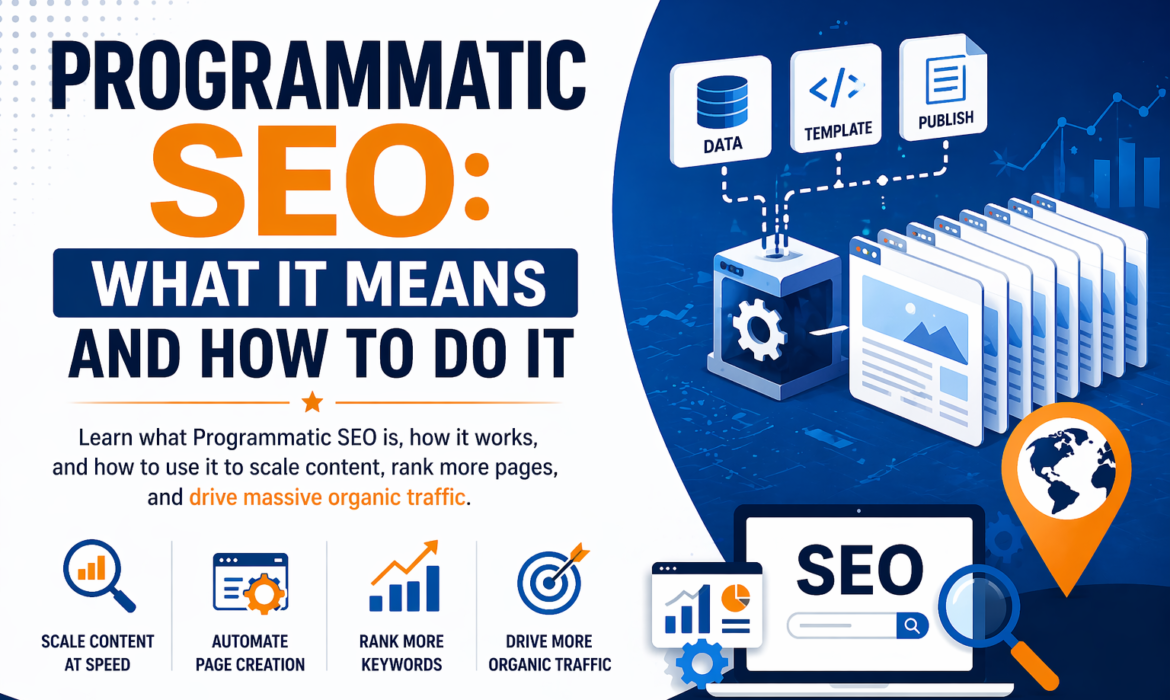
Programmatic SEO (pSEO) is the practice of using automation, structured data, and page templates to create large numbers of search-optimised pages at scale. Instead of writing each page from scratch, you identify a repeatable keyword pattern and generate pages programmatically from a database or data source.
The concept isn’t new. But in 2026, the combination of accessible AI tools, improved automation platforms, and richer data sources has made programmatic SEO more achievable for a broader range of businesses than ever before.
This guide covers everything you need to know: what programmatic SEO actually is, how it works, who it’s suited to, real-world examples from companies doing it well, a step-by-step implementation process, the risks to avoid, and how to measure performance.
What Is Programmatic SEO?
Programmatic SEO is the systematic creation of web pages at scale using templates and structured data to target large numbers of related search queries simultaneously.
The core formula is straightforward:
Scalable keyword pattern + structured data + page template = pages at scale
In traditional SEO, a team writes one article targeting one keyword. In programmatic SEO, a team builds one template and populates it with data to generate hundreds or thousands of unique pages, each targeting a different variation of the same keyword pattern.
Every programmatic page uses the same structural layout. What changes is the data that fills it: the city name, the product specification, the currency pair, the job title, the comparison variable. The template stays constant; the content varies.
The four core components
A functioning programmatic SEO system has four interdependent parts:
- Data source: The structured database, spreadsheet, or API that supplies the unique variables for each page. This is the foundation. Without quality data, the entire system produces thin, low-value content.
- Page templates: The reusable layout that defines how each page looks and what elements it contains. Templates include headings, body copy structures, images, tables, and CTAs.
- Automation workflow: The technical process that connects the data source to the template and publishes pages at scale. This can range from a simple CMS setup to a fully custom-built pipeline.
- Monitoring system: The analytics and quality control layer that tracks indexation, rankings, traffic, and page health across the entire page set.
Who programmatic SEO is suited to
Not every business has a use case for programmatic SEO. It works best when three conditions are met:
- You have access to a large, structured dataset with meaningful variation between data points
- Your target audience is searching for queries that follow a consistent, repeatable pattern
- The number of keyword variations is large enough to justify building an automated system rather than writing pages manually
Businesses that typically meet these criteria include e-commerce platforms, travel and hospitality sites, real estate platforms, SaaS tools with integration or comparison use cases, financial services with currency or rate data, and local services operating across multiple geographic markets.
Programmatic SEO vs Traditional SEO: Key Differences
Understanding how programmatic SEO differs from traditional SEO clarifies when each approach is appropriate and why they are not competing strategies.
| Aspect | Traditional SEO | Programmatic SEO |
|---|---|---|
| Page creation | Manual, one page at a time | Automated, hundreds to millions of pages |
| Content approach | Unique article per keyword | Template populated with variable data |
| Keyword targeting | Individual high-value terms | Patterns across thousands of long-tail variations |
| Time to scale | Months to years | Weeks to months once the system is built |
| Team requirement | Writers, editors, strategists | Developers, data managers, SEO strategists |
| Best for | Authority content, complex topics | Structured data with repeatable patterns |
| Primary risk | Slow growth | Thin content, indexation issues |
| Upfront investment | Low (content costs) | High (system build costs) |
Why do they complement each other
Traditional SEO and programmatic SEO are most effective when used together. Traditional SEO builds authority through in-depth, editorially rich content that earns backlinks and establishes topical expertise. Programmatic SEO captures the long tail, ranking for thousands of specific, lower-competition queries that no editorial team could manually address at scale.
The practical division: Use traditional SEO for your pillar content, thought leadership, and competitive head terms. Use programmatic SEO to systematically capture the long-tail query space where your data gives you a structural advantage.
The authority built through traditional SEO also benefits programmatic pages. A domain with strong backlinks and established topical authority will see its programmatic pages indexed and ranked more readily than a new domain attempting the same approach from scratch.
Real-World Examples of Programmatic SEO Done Well
The clearest way to understand programmatic SEO is to look at how established companies have implemented it. Each of the following examples illustrates a different approach to the same core strategy.
Zapier: integration pages at scale
Zapier has built over 800,000 landing pages targeting queries like “How to connect [App A] to [App B].” Every page follows the same template: an explanation of the integration, step-by-step setup instructions, and a CTA to create a free account. The data source is Zapier’s own integration database, which contains thousands of app connections. Because the data is proprietary and the pages solve a real user need, Google treats them as genuinely useful content rather than thin spam.
Why it works: Zapier owns the data. No competitor can replicate the exact same pages using the same source, which gives their programmatic strategy built-in defensibility.
Wise: currency conversion pages
Wise (formerly TransferWise) has over 10,000 pages targeting currency conversion queries like “Convert USD to AUD” or “GBP to EUR exchange rate.” Each page pulls live rate data from financial APIs, displays conversion calculators, and provides context about transfer fees and timing. The real-time data element means each page is genuinely useful and stays current without manual updates.
TripAdvisor: destination and category pages
TripAdvisor operates millions of programmatic pages targeting patterns like “Best hotels in [city]”, “Top restaurants in [neighbourhood]”, and “Things to do in [destination]”. Each page combines user-generated reviews, star ratings, photos, and structured location data. The user-generated content element solves the thin content problem that plagues many programmatic implementations: every page has unique, meaningful content that no template alone could produce.
Canva: template library pages
Canva generates over 100,000 pages targeting queries like “Free [document type] template” and “[colour] [document type] template.” Each page showcases a specific template from their library, with metadata, preview images, and related template suggestions. The data source is their own template library, and the pages serve genuine search intent for users looking for specific design starting points.
The common thread
| Company | Keyword pattern | Estimated pages | Data source |
|---|---|---|---|
| Zapier | “[App A] to [App B] integration” | 800,000+ | Internal integration database |
| Wise | “[Currency A] to [Currency B]” | 10,000+ | Real-time financial APIs |
| TripAdvisor | “Best [X] in [city]” | Millions | User reviews and location data |
| Canva | “Free [document type] template” | 100,000+ | Template library metadata |
| Zillow | “[Address/suburb] property listings” | Millions | Property listing database |
The pattern across all successful implementations: proprietary or enriched data, genuine user value on every page, and a keyword pattern with enough variation to justify the system investment.
How to Do Programmatic SEO: A Step-by-Step Process
Building a programmatic SEO system requires careful planning before any pages are published. Rushing the build phase is the most common cause of programmatic SEO failures.
Step 1: Find a scalable keyword pattern
The foundation of any pSEO strategy is a keyword pattern that generates enough variations to justify building at scale. You are looking for a “head term + modifier” structure where the modifier can change across dozens or hundreds of values.
Good programmatic keyword patterns follow formats like:
- [Product] vs [competitor] (comparison pages)
- Best [category] in [city] (location-based pages)
- Convert [currency A] to [currency B] (utility pages)
- [Tool] for [use case] (attribute-based pages)
- Average salary for [profession] (data-driven pages)
- [App A] to [App B] integration (integration pages)
Use keyword research tools like Ahrefs or Semrush to validate that enough variations of your chosen pattern have search volume. A pattern with only three or four searchable variations doesn’t justify a programmatic build. A pattern with three hundred does.
Keyword difficulty threshold: Target patterns where the majority of variations have a Keyword Difficulty (KD) below 30. Low-competition long-tail queries are where programmatic SEO delivers the most reliable results.
Step 2: Build or acquire your data source
Your data source determines the ceiling for your programmatic strategy. There are two categories:
Proprietary data is information you own or generate that competitors cannot access. Zapier’s integration database, Zillow’s property listings, and TripAdvisor’s review database are all proprietary. This is the gold standard because it creates defensibility: competitors cannot simply replicate your pages using the same source.
Public data with added value uses information from government databases, open APIs, or public records, but transforms, combines, or presents it in ways that create genuine additional value. Because anyone can access the same raw data, the differentiation comes from how you present it.
At minimum, aim for 1,000 unique, meaningful data points. Successful large-scale implementations typically require tens of thousands.
Step 3: Design your page template
Your template defines what every page looks like and what it contains. A well-designed template for programmatic SEO includes:
- A clear H1 that incorporates the target keyword variation
- 500 to 1,000 words of helpful content structured with headings and bullet points
- Conditional content logic that adapts copy, examples, or CTAs based on the specific data
- Rich elements such as tables, maps, calculators, or comparison charts that visualise the data
- Internal links to related pages, category hubs, and deeper resources
- Unique meta title and description dynamically generated for each variation
The most important design principle: every page must provide genuine value to the user who lands on it. A template that produces pages where the only unique element is a city name or product name will be treated as thin content by Google.
Step 4: Set up the technical infrastructure
The technical layer connects your data source to your template and handles publishing at scale. Common approaches include:
- CMS-based builds using platforms like WordPress with custom post types and dynamic fields, or Webflow with CMS collections
- Headless CMS setups, where content is managed separately from the front end, allow for more flexible data integration
- Custom-built pipelines for large-scale or complex implementations that require proprietary logic
Regardless of the approach, ensure your setup handles:
- Canonical tags to prevent duplicate content issues between similar pages
- Proper robots.txt configuration to allow search engine crawling
- XML sitemaps that update automatically as new pages are published
- Schema markup (Article, Product, LocalBusiness, or FAQ schema, depending on page type)
- Fast page load times across the entire page set, not just individual pages
Step 5: Publish in controlled batches
Don’t publish all pages at once. Start with a batch of 50 to 200 pages covering your highest-priority keyword variations. Monitor how Google indexes and ranks them before scaling further.
This staged approach serves two purposes. First, it allows you to identify template or data quality issues before they affect thousands of pages. Second, it gives you real performance data to validate your keyword pattern assumptions before committing to a full build.
Step 6: Monitor, iterate, and expand
Once your initial batch is live, track three core metrics: indexation rate (what percentage of published pages Google is indexing), rankings (are pages appearing in search results for their target queries), and traffic per page (are indexed pages driving visits).
Identify underperforming pages and determine whether the issue is data quality, template design, or keyword pattern validity. Fix the root cause at the template level, which updates all pages simultaneously, rather than addressing individual pages manually.
Google Search Console is the primary tool for monitoring indexation and ranking performance. Google Analytics tracks traffic and user behaviour at the page level.
Risks and Pitfalls to Avoid
Programmatic SEO has a significant failure rate, and most failures share the same root causes. Understanding these risks before you build is the most effective way to avoid them.
Thin content at scale
This is the most common and most damaging mistake. Thin content is content that provides little or no genuine value to the reader beyond what is already available on competing pages. When a programmatic template produces pages where the only difference is a single variable (a city name, a product colour, a currency code) and the surrounding content is identical or near-identical across all pages, Google classifies those pages as thin.
The consequence is significant. Google’s helpful content system can devalue an entire domain if it determines that a large proportion of its pages are low-quality. A programmatic build gone wrong doesn’t just fail to rank. It can actively harm the rest of your site.
The fix: ensure every page contains meaningful, unique content beyond the variable data. This might come from user-generated content, real-time data feeds, conditional logic that produces genuinely different copy based on the data, or rich media elements that vary by page.
Keyword cannibalism
When programmatic pages target overlapping keyword variations, they compete with each other for the same search queries. Google struggles to determine which page to rank, and both pages perform worse than a single consolidated page would.
Audit for cannibalism before publishing at scale. Use Google Search Console to check whether multiple pages from your domain are appearing for the same query. If they are, consolidate or differentiate the competing pages.
Indexation problems
Publishing thousands of pages doesn’t guarantee Google will index them. Google allocates crawl budget based on site authority and page quality. A new domain publishing 50,000 pages simultaneously will see most of them ignored. Even established domains can face indexation challenges if programmatic pages are perceived as low quality.
Signs of indexation problems:
- Pages not appearing in Google Search Console’s coverage report
- Low crawl frequency in GSC’s crawl stats
- Pages indexed but not appearing in search results for their target queries
Solutions include improving page quality, building internal links to programmatic pages from high-authority sections of your site, submitting sitemaps regularly, and using the URL Inspection tool in Search Console to request indexation of priority pages.
Template bugs at scale
A single error in your template can propagate across every page simultaneously. A broken canonical tag, an incorrect meta description pattern, or a missing schema element doesn’t affect one page. It affects all of them.
Build quality control checks into your automation workflow before publishing. Test your template thoroughly on a small batch before scaling. Set up automated monitoring that alerts you to template-level issues as soon as they appear.
Over-reliance on public data
If your data source is publicly accessible and not uniquely transformed, competitors can build identical pages using the same data. This creates a race to the bottom where multiple sites publish near-identical programmatic pages, and Google has no clear reason to favour any one of them.
The solution is to either use proprietary data or add a layer of unique value on top of public data: original analysis, contextual commentary, user-generated content, or data combinations that competitors haven’t assembled.
How AI Is Changing Programmatic SEO in 2026
AI tools have meaningfully lowered the barrier to entry for programmatic SEO, while simultaneously raising the quality bar that Google expects.
What AI enables
In previous years, programmatic SEO was largely limited to sites with access to structured databases and development resources. AI has changed this in two ways.
First, AI tools can generate meaningful, varied content from structured data inputs. Rather than producing identical boilerplate text for every page with only the variable swapped, AI-powered content generation can produce contextually different copy based on the specific data point. A page about “best CRM for real estate agents” can have genuinely different content from a page about “best CRM for law firms,” even when both are generated programmatically from the same template structure.
Second, AI tools have made keyword pattern identification faster and more comprehensive. What previously required days of manual keyword research can now be completed in hours using AI-assisted clustering tools.
The quality bar has risen
The same AI accessibility that benefits pSEO practitioners has also flooded the web with low-quality AI-generated content. Google’s helpful content system has become more sophisticated in detecting and devaluing pages that exist primarily to capture search traffic rather than serve genuine user needs.
The practical implication: AI-assisted programmatic SEO works when AI is used to enhance content quality, not to replace the need for genuine data and user value. Using AI to generate slightly varied versions of the same thin content at scale is the fastest path to a helpful content penalty.
The highest-performing programmatic implementations in 2026 use AI to add analytical context, generate conditional content logic, and improve template copy, while still grounding every page in unique, structured data that no AI tool can fabricate.
Programmatic SEO and AI search
As AI-generated search results (Google AI Overviews, Perplexity, ChatGPT) become more prevalent, programmatic pages face an additional challenge. AI search engines synthesise information from multiple sources rather than directing users to individual pages. This means programmatic pages that previously captured traffic from informational queries may see reduced click-through rates as AI engines answer those queries directly.
The response is to ensure programmatic pages provide interactive, tool-based, or transactional value that AI summaries cannot replicate. A currency conversion calculator, a real-time property price comparison, or a personalised recommendation engine serves user needs that a synthesised text answer cannot replace.
Measuring Programmatic SEO Performance
Measurement for programmatic SEO requires a different framework from traditional SEO. You are not monitoring the performance of individual pages. You are monitoring the health of a system that may contain thousands of pages simultaneously.
Key metrics to track
| Metric | What It Measures | Primary Tool |
|---|---|---|
| Indexation rate | % of published pages Google has indexed | Google Search Console |
| Crawl frequency | How often does Google visit your programmatic pages | GSC Crawl Stats |
| Traffic distribution | Which page variations drive the most visits | Google Analytics |
| Average position by page type | Ranking performance across page categories | GSC Performance Report |
| Bounce rate and time on page | Whether users find value after landing | Google Analytics |
| Conversion rate by page type | Which variations drive valuable actions | GA4 Goals / Events |
| Keyword cannibalism rate | Pages competing for the same queries | GSC, Semrush |
| Page-level Core Web Vitals | Load speed and user experience across the page set | PageSpeed Insights, GSC |
Interpreting the data
Successful programmatic SEO campaigns, according to enterprise SEO research, typically see 40 to 60% of published pages earning at least some organic traffic within six months. Top-performing page categories achieve 80%+ indexation and traffic rates. If your indexation rate is significantly below 40% after three months, it signals either a data quality problem, a technical crawlability issue, or a keyword pattern that lacks sufficient search demand.
Don’t optimise for traffic volume alone. A page that ranks well but has a 90% bounce rate indicates a mismatch between the page content and what the user actually needed. Focus on metrics that indicate genuine user value: pages per session, conversion rates, and return visitor rates.
Ongoing optimisation cadence
Programmatic SEO is not a one-time build. Plan for:
- Monthly reviews of top-performing and bottom-performing page categories
- Quarterly template updates based on performance data and search intent shifts
- Data refreshes to keep dynamic content current (stale data loses rankings over time)
- Prune or improve decisions for pages that have been indexed for six months or more with zero traffic
Is Programmatic SEO Right for Your Business?
Programmatic SEO is a powerful strategy, but it is not universally applicable. Before committing to the investment, it’s worth honestly assessing whether the conditions for success exist in your specific situation.
Signs programmatic SEO is a strong fit
- You have access to a structured dataset with thousands of unique, meaningful data points
- Your target audience searches for queries that follow a consistent, repeatable pattern
- Your domain already has meaningful authority (DR 40 or above is a reasonable baseline)
- You have development resources to build and maintain the technical infrastructure
- The long-tail keyword space in your category is large enough to justify the system investment
Signs programmatic SEO is the wrong approach
- Your business operates in a niche where the total addressable keyword pattern produces fewer than 100 meaningful variations
- Your data source is thin, inaccurate, or identical to what competitors can easily access
- Your domain has low authority and no established topical credibility in the target space
- You don’t have development resources or a budget to build a proper technical implementation
- The queries you’re targeting require nuanced, editorial content that templates cannot adequately serve
The honest assessment
Programmatic SEO done well is a compounding, durable competitive advantage. Companies like Zapier, Wise, and TripAdvisor have built organic traffic machines that are extremely difficult for competitors to replicate because the underlying data and systems took years to build.
Programmatic SEO done poorly is a liability. Thin content at scale, indexation problems, and template bugs can harm your entire domain, not just the programmatic pages. The difference between the two outcomes comes down to data quality, template design, and the discipline to build for user value rather than search engine manipulation.
The realistic starting point for most businesses: Begin with a small, well-validated batch of 50 to 100 pages before committing to a full-scale build. Use that initial batch to confirm that your keyword pattern has genuine search demand, that your data produces meaningful page differentiation, and that Google is willing to index and rank what you’ve built. Scale only once those fundamentals are confirmed.
Final Thoughts
Programmatic SEO is one of the few organic growth strategies that can genuinely scale without a proportional increase in resources. When the conditions are right, it allows a relatively small team to build a search presence that would be impossible to achieve through traditional content production alone.
But the conditions matter enormously. Data quality, template design, domain authority, and a genuine commitment to user value are not optional extras. They are the difference between a programmatic build that drives sustained organic growth and one that creates a crawl budget problem and a helpful content penalty.
The companies that have made programmatic SEO work at the highest level share a common approach: they started with data they owned or uniquely understood, they built templates that produced pages with real value for real users, and they treated the system as a long-term investment requiring ongoing maintenance rather than a one-time build.
The core principle is simple, even if the execution is not. Programmatic SEO succeeds when every page it produces is worth visiting if a user landed on it directly from a search result. If the answer to that question is yes, you have a solid foundation. If the answer is “it depends on the variable,” you have more template work to do.
Start small, validate your assumptions, measure what matters, and scale what works. That’s the approach that produces durable results.
